Beyond Unemployment: Preparing for the Jobs Ahead
Vivacity Development’s Nigeria Works Initiative asks the following pertinent questions: What will work look like for Nigerians in 2030? Which jobs will remain in demand, which skills will employers increasingly require, and how prepared are we to take advantage of the opportunities emerging from AI, technological innovation, and the global transition to a green economy?
At Vivacity Development, these are the questions we are bringing to the centre of Nigeria’s development conversation through our Future of Work initiative under the umbrella of “Nigeria Works. For too long, our national conversation has been trapped in a single statistic: the unemployment rate. It is an important number, but it hides a more dangerous reality. A nation can have low unemployment and still be deeply unprepared for the future. People can be working today in jobs that will not exist tomorrow, with skills that will not be relevant next year. The future of work is not something that will happen in 2030. It is happening now.
The Global Shift Is Already Underway
The data is unequivocal. According to the World Economic Forum’s Future of Jobs Report 2025, global labour-market transformation will be profound. By 2030, 170 million new jobs will be created globally while 92 million jobs will be displaced, resulting in a net increase of 78 million jobs. That is not job loss. That is job change. What is driving that change? Three forces are driving this change:
• First, technological change, especially Artificial Intelligence, automation, and data. AI is not just coming for factory jobs. It is reshaping white-collar work — customer service, accounting, legal research, marketing, and even coding. The question is no longer whether AI will affect your work, but how.
• Second, the green transition. The global move to a net-zero economy is creating entirely new industries and redefining old ones. From renewable energy to sustainable agriculture to circular economy and climate-smart infrastructure, the green economy is projected to be a multi-trillion-dollar job creator this decade.
• Third, demographic and economic fragmentation. Supply chains are being rewired, new care economies are emerging, and resilience — food security, energy security, health security — is becoming a job driver. For Nigeria, with a median age of 18.1 and over 60% of our population under 25, this global shift is both our greatest risk and our greatest opportunity.
We are Africa’s largest workforce. By 2030, we will be one of the three largest youth workforces in the world. The world will need workers. The question is whether those workers will be ready, and whether they will be Nigerian.
Beyond Unemployment: The Skills Mismatch Crisis
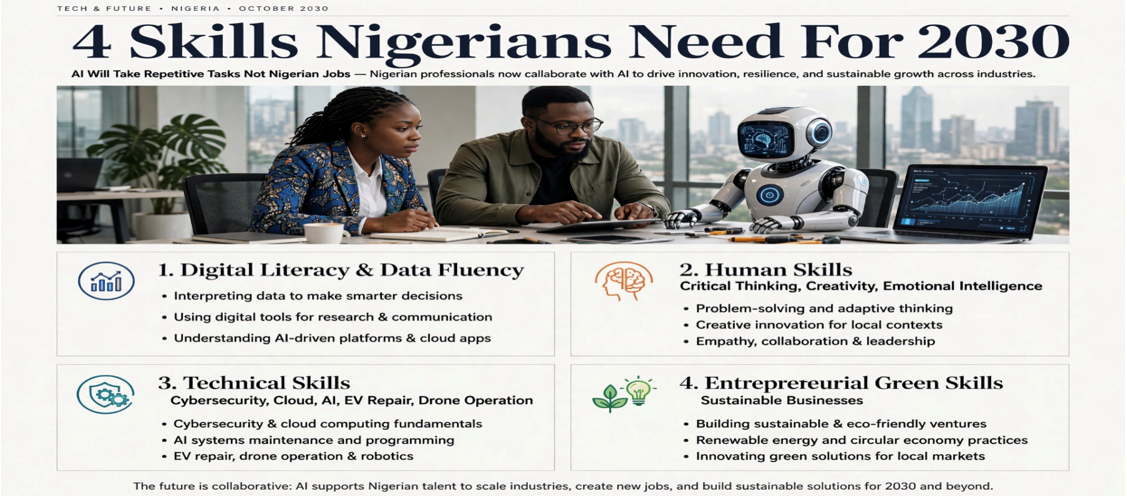
Nigeria’s employment conversation must move beyond unemployment numbers to employability and productivity. Consider three people. Amaka is 28, employed as a customer service officer in a bank in Lagos. She is diligent, but her day-to-day work — answering routine queries, processing forms — is increasingly being automated by chatbots. Unless she upskills into customer experience design, data analysis, or relationship management, her job security is fragile even while she is employed. Tunde is 35 and runs a logistics business in Kano with five staff. He works hard, but struggles with fuel costs, poor route optimisation, and inventory losses. He has never used digital logistics tools, route optimisation software, or data analytics. His business is surviving, not scaling, because the technological skills gap is directly costing him profit. Chioma graduated two years ago with a Second Class Upper in Economics. She has a good certificate but no practical experience with Excel modelling, data visualisation, or digital marketing tools that employers now list as basic requirements. She is educated but not yet employable in the modern economy. These three stories are the real future of work crisis. It is not just that there are no jobs. It is that the jobs that exist and the jobs that are coming require a different set of skills than our education and training systems currently provide. Our goal with Nigeria Works is simple: awareness and preparation. People cannot prepare for opportunities they do not know exist, and they cannot acquire skills they do not yet realise they need.
The Green Economy: Nigeria’s Biggest Untapped Frontier
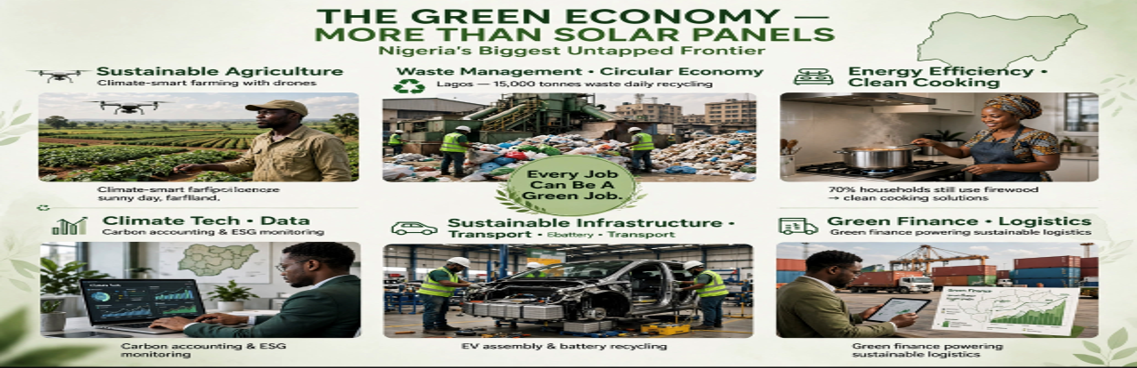
When most people hear “green economy,” they think of solar panels on rooftops. That is part of it, but it is less than 20% of the story. The transition to a net-zero economy is one of the largest economic transformations in human history. And it goes far beyond renewable energy. It includes:
• Sustainable Agriculture: Climate-smart farming, precision agriculture using drones and soil sensors, post-harvest loss reduction, regenerative agriculture, and agro-processing that reduces waste. Nigeria loses 40-50% of our food post-harvest. Solving that with cold-chain logistics, solar drying, and processing is a green job and a food security solution
• Waste Management and Circular Economy: Lagos alone generates 15,000 tonnes of waste daily. Turning waste to wealth — plastic recycling, e-waste recovery, organic waste to compost and biogas, building materials from waste — is a multi-billion-naira industry that already employs thousands informally but can be formalized and scaled.
• Energy Efficiency and Clean Cooking: Over 70% of Nigerian households still use firewood or charcoal for cooking. Transitioning to clean cooking solutions, energy-efficient appliances, and green building design is not just an environmental need. It is a massive market for technicians, sales agents, installers, and maintenance workers.
• Climate Tech and Data: Carbon accounting, ESG reporting, climate risk analysis, satellite monitoring for deforestation, and digital tools for farmers — these require data analysts, software developers, and field officers who understand both technology and climate.
• Sustainable Infrastructure and Transport: EV assembly and maintenance, battery recycling, bus rapid transit management, sustainable construction using local materials — all green jobs that require welders, electricians, mechanics, architects, and engineers trained in new standards. The critical insight is this: The green economy does not only create jobs for environmental scientists. It creates jobs for project managers, data analysts, logistics specialists, communications practitioners, accountants, and entrepreneurs. Every job can be a green job if we build the right skills around it. But these opportunities will not automatically translate into jobs for Nigerians unless we intentionally bridge the gap between awareness, practical training, and real-world application. Intentionality is the difference between a global transition that leaves us behind and one that creates prosperity here.
AI and Tech: Not Replacing Nigerians, Growing but Redefining Nigerian Work.
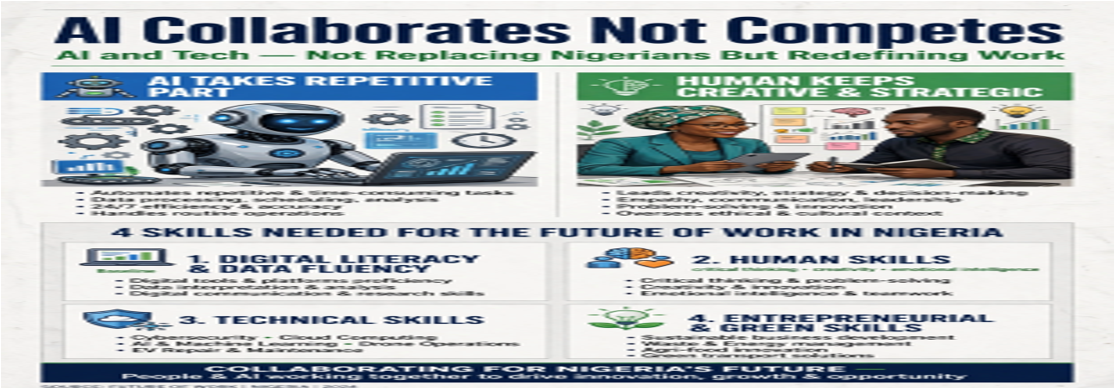
There is growing fear that AI will take over Nigerian jobs. The more accurate statement is that AI will take the repetitive part of every job, leaving the human, creative, and strategic parts. For a lawyer, AI can draft a basic contract, but it cannot negotiate a complex land dispute in Ibadan. For an accountant, AI can reconcile entries, but it cannot advise a small business on cash flow strategy. For a teacher, AI can create lesson plans, but it cannot mentor a child.
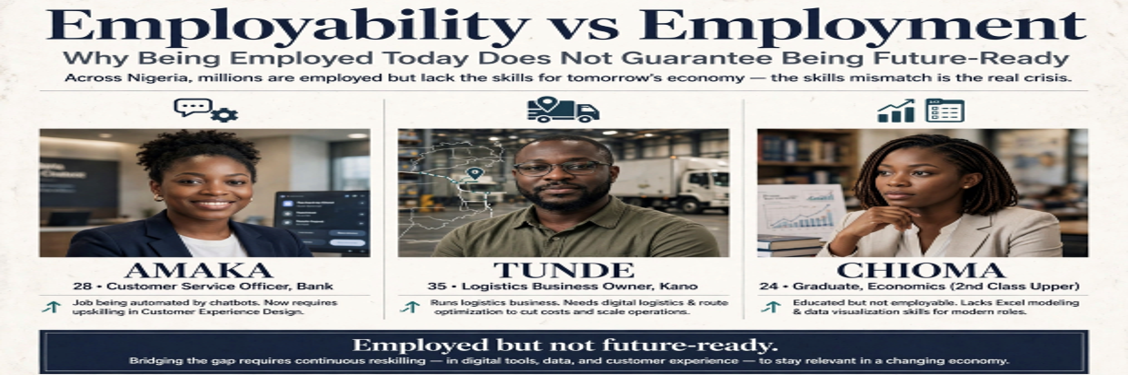
The Nigerians who will thrive by 2030 will not be those who compete with AI, but those who collaborate with it. What skills does that require?
• First, Digital literacy and data fluency, as a baseline. Not everyone needs to be a coder, but everyone needs to be comfortable with digital tools, spreadsheets, data dashboards, and AI assistants. This is the new literacy.
• Second, Human skills that AI cannot replicate: critical thinking, complex problem solving, creativity, emotional intelligence, leadership, and adaptability. The World Economic Forum calls these the skills that will have the fastest growth in demand by 2030.
• Third, *technical skills in growth sectors: cybersecurity, cloud computing, AI and machine learning, renewable energy installation and maintenance, drone operation for agriculture, and EV repair.
• Fourth, entrepreneurial and green skills: ability to identify a problem in waste, energy, food, or transport and build a business around solving it sustainably. Our education system currently does not teach most of these at scale. Our challenge is to build a massive, decentralised skilling ecosystem outside the formal classroom — through apprenticeships, digital learning, boot camps, and employer-led training.
Our Journey: From London to UNGA to COP31
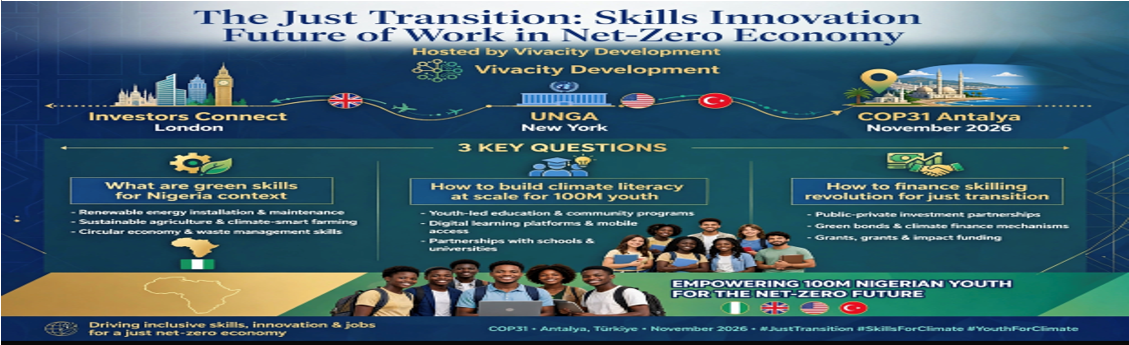
At Vivacity Development, we have been intentional about not having this conversation in isolation. Our Future of Work agenda builds on a continuous journey of international dialogues — from Investors Connect London, where we connected Nigerian innovators to global capital, to our convening around the United Nations General Assembly in New York, where we brought Nigeria’s talent agenda to the centre of global development conversations. We have learned one thing consistently: the world is interested in Nigerian talent, but they are looking for ready talent.
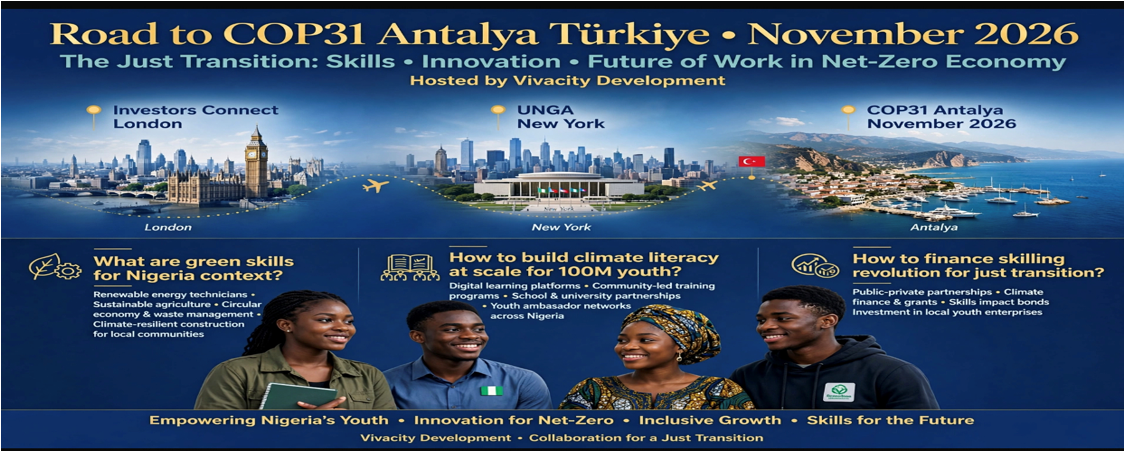
This November 2026, we are taking the next step. Vivacity Development will be taking this agenda to the “31st United Nations Climate Change Conference, COP31, in Antalya, Türkiye”. We will be hosting a high-level convening themed: “The Just Transition: Skills, Innovation and the Future of Work in a Net-Zero Economy.” This is not a side event. It is a strategic convening. We will bring together leaders from government, industry, development finance, academia, and innovation from Nigeria, Africa, and globally to explore three critical questions:
• One, what are green skills, and how do we define them for the Nigerian context, not just imported definitions?
• Two, how do we build climate literacy and green skills at scale for 100 million youth, not just for 1,000 fellows in Lagos?
• Three, how do we finance the skilling revolution required for a just transition, so that young people in Sokoto, Aba, and Makurdi have the same access as those in London and Nairobi?
A just transition must mean that Nigerian youth are not spectators watching the green economy happen on television, but participants — as skilled workers, innovators, entrepreneurs, and owners.
Preparing Before the Future Arrives
The future of work will not wait for Nigeria to be ready. Automation is already in our banks. AI is already writing content for our SMEs. Solar installers are already in demand across our states. What we do in the next 36 months will determine whether Nigeria in 2030 is a supplier of raw talent and raw materials, or a creator of value and solutions. Preparing for the future of work must begin before the future arrives. The shifts are already taking place in our workplaces, on our farms, and in our markets. This is why Nigeria Works exists. Our initiative rests on three pillars: *Awareness* — making sure every young Nigerian knows what jobs are emerging; *Access* — connecting people to practical training, mentorship, and tools, not just theory; and *Application* — linking skilled people to real jobs, markets, and capital. The decisions we make now about awareness, skills, and preparedness will determine how well our people and businesses thrive in 2030. Nigeria has the people. Africa has the largest young workforce in the world. What we need now is the preparation. Nigeria Works is our commitment to ensure that when the world asks who is ready for the jobs of the future, Nigeria can answer: We are.
For more information, clarifications and support, Contact Prof. Prisca Ndu on +2348033086190 or [email protected]
Related News

Dr. Prisca Ndu who holds four doctorate degrees in Credit Management, Banking and Finance, Leadership and Management and Artificial Intelligence, is a social impact advocate and multi-sector entrepreneur. An alumnus of the University of Ibadan, Lagos Business School, Harvard Business School, London Graduate School, Institute of Management Development, INSEAD and Robert Kennedy College, Switzerland, amongst others. She sits on the Board of several companies including INDECO, KREENO Consortium, BHLA Awards, and many more. She was listed in 2017 among the most influential people of African descent by the United Nations and is passionate about Nation Building.


Source: