…But households and businesses may wait longer for relief
Nigeria’s headline inflation rate is projected to decline to 13.99 percent in October 2026, extending its downward trend for a fifth consecutive month. But while slower price increases could ease pressure on household budgets and business operations, the improvement may take longer to translate into cheaper essentials, stronger purchasing power and lower production costs.
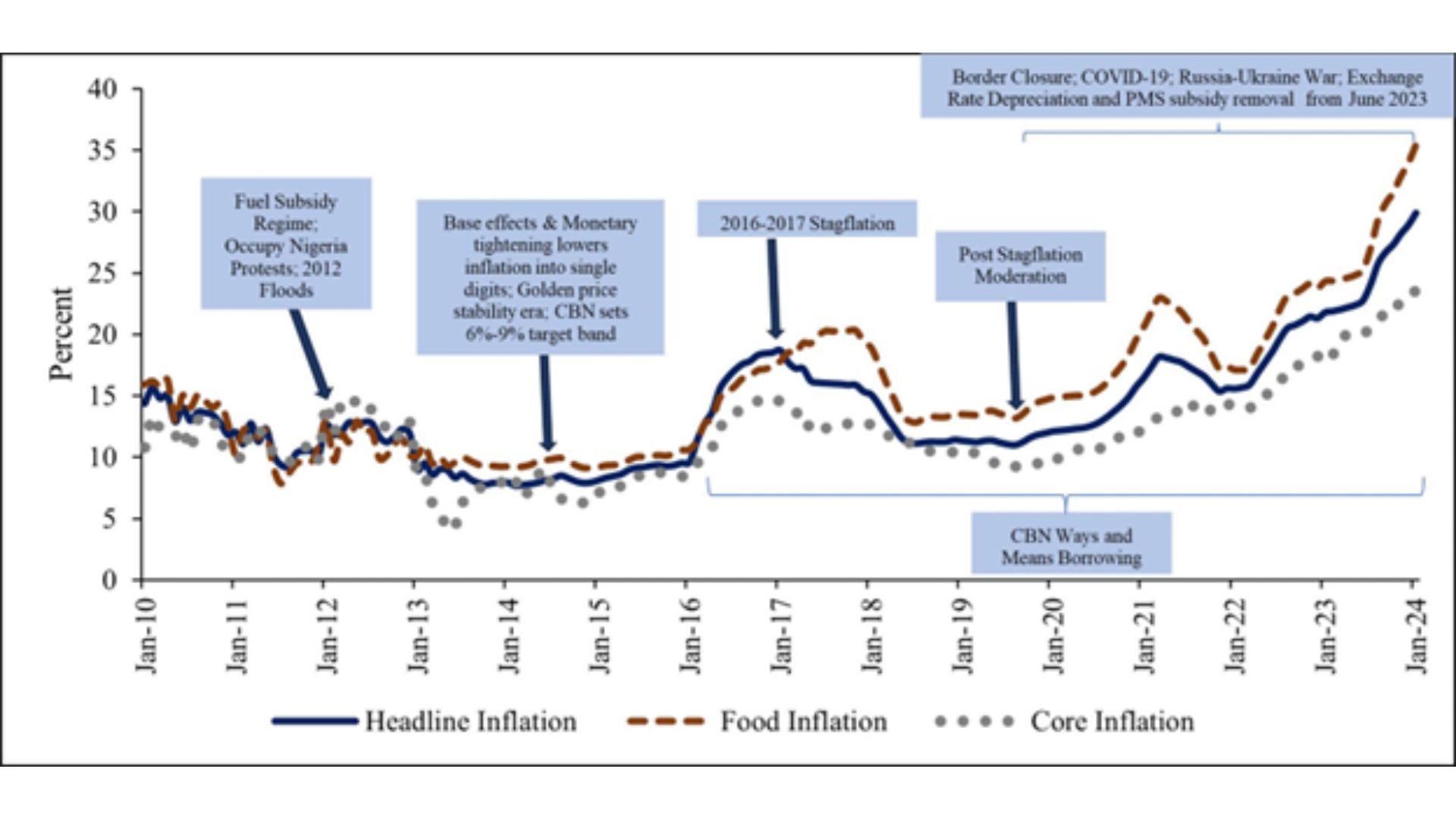
BusinessDay’s inflation forecast estimates a 0.64 percentage-point decline from the 14.63 percent recorded by the National Bureau of Statistics (NBS) in September. If confirmed, it would extend the moderation from 15.93 percent in May to 15.91 percent in June, 15.43 percent in July, 15.39 percent in August and 14.63 percent in September.
The projection points to a gradual improvement in the inflation outlook, but falling inflation does not mean falling prices. It means prices are rising more slowly, not that food, transport, electricity and other essentials are becoming cheaper. For households already struggling with the cumulative increase in living costs, the level at which prices have settled remains as important as the pace of further increases.
Read also: AFRICA FINANCE IN BRIEF: Bigger GDP figures, sticky inflation and new credit ratings
Businesses face a similar challenge. More predictable prices could improve decisions on inventory, wages, investment and pricing, but high energy, logistics, imported-input and financing costs continue to constrain production. The economic value of disinflation will ultimately depend on whether it improves household purchasing power and reduces the cost of doing business.
Household relief depends on income growth
For households, the real test of lower inflation is how much income remains after paying for necessities. Food, transport, housing, healthcare and education absorb a substantial share of earnings, leaving many families with limited room for savings or discretionary spending.
A sustained slowdown in price increases could gradually ease pressure on household budgets. If wages and other income sources begin to grow faster than prices, purchasing power could recover, allowing families to spend more on goods and services beyond basic necessities. That would also support businesses dependent on domestic consumer demand.
However, the benefit will not be uniform. Food prices can move differently from the headline index, while transport and electricity expenses remain exposed to fuel prices, distribution costs and infrastructure constraints. Households may therefore continue to experience financial pressure even as the national inflation rate declines.
When families devote a growing share of their income to essentials, spending on clothing, household goods, leisure and other services suffers. Businesses consequently face weaker demand, potentially affecting revenue, investment and employment. A recovery in real household income would therefore support both welfare and economic activity.
Businesses need lower operating costs
For employers, sustained disinflation offers an opportunity to plan with greater certainty. More predictable prices can improve decisions on inventory, selling prices, wage adjustments and capital expenditure, while reducing uncertainty around the cost of working capital and imported production inputs.
Yet headline inflation does not fully reflect the pressures facing individual sectors.
Read also: Ghana inflation hits 11-month high as transport costs drive non-food prices
Manufacturers remain exposed to electricity and fuel costs, exchange-rate movements and imported raw materials. Farmers and food processors contend with fertiliser, storage, transport and distribution expenses. Retailers and service providers must manage the cost of moving goods, maintaining inventory and keeping their operations running.
The burden is particularly heavy for micro, small and medium-sized enterprises (MSMEs), which often have limited access to affordable credit and less bargaining power with suppliers. Their ability to absorb rising costs is also weaker. Some respond by reducing profit margins, postponing investment, limiting recruitment or passing additional expenses to consumers.
A lower inflation rate would provide a more favourable operating environment, but it cannot independently resolve these constraints. Businesses need reliable electricity, efficient logistics, affordable financing and stronger domestic supply chains to convert macroeconomic stability into higher productivity and competitiveness.
Stability alone cannot fix structural costs
Sustaining the disinflationary trend will require credible monetary policy, exchange-rate stability and fiscal discipline. These remain important for containing inflation expectations, limiting imported price pressures and supporting confidence in the economy.
However, monetary stability can slow the pace at which costs rise; it cannot, by itself, make electricity more reliable, move agricultural produce more efficiently or reduce the cost of transporting goods. Without improvements in these areas, lower inflation could coexist with an expensive business environment.
Stronger domestic food production and distribution would help reduce supply disruptions and the cost of moving agricultural produce to markets. More reliable electricity could lower businesses’ dependence on expensive alternative power sources, while improved roads, storage and logistics infrastructure would reduce distribution expenses.
Read also: Nigeria’s net FX inflows surge nearly tenfold in four years
Access to finance is equally important. Even if inflation moderates, businesses may struggle to expand when borrowing costs remain high, or credit is difficult to obtain.
Smaller firms, in particular, need affordable working capital to maintain inventory, invest in equipment and respond to changes in demand.
The policy challenge is therefore to consolidate macroeconomic stability while addressing the structural weaknesses that keep production costs high. Without that combination, the benefits of lower inflation may remain limited for both households and employers.
What the forecast says
BusinessDay’s October projection is based on a monthly econometric model estimated using 69 observations covering January 2020 to September 2026. The model examines the relationship between headline inflation and its previous-month and twelve-month lags, exchange-rate movements and business activity.
The inflation variables capture the persistence of price movements, while exchange-rate changes account for the effect of naira movements on imported goods, machinery and production inputs. Business activity is measured using the Stanbic IBTC Purchasing
Managers’ Index (PMI), an indicator of private-sector operating conditions.
The model also accounts for the January 2025 rebasing of the Consumer Price Index, which changed the framework used to measure inflation. Alternative specifications were assessed before the final model was selected based on statistical performance and economic interpretation.
Read also: New minimum wage must reflect inflation, exchange rate – Ajaero insists
The projection nevertheless carries uncertainty. The period covered by the rebased CPI remains relatively short, limiting the available observations for assessing economic relationships under the new measurement framework. Stability checks also suggest that some relationships may still be adjusting. In addition, the model cannot anticipate sudden shocks such as sharp exchange-rate movements, fuel-price changes or unexpected supply disruptions.
The forecast standard error is 2.5 percentage points, with an approximate 95 percent prediction interval of 9.09 to 18.89 percent, subject to the model’s prediction-interval assumptions. The wide range reflects uncertainty around the central estimate. The 13.99 percent projection should therefore be treated as an indication of the possible direction of inflation, not a guaranteed outcome.
The October NBS release will provide the test of the projection. But the more consequential measure of progress lies beyond the inflation index: whether households can meet more of their needs with their incomes and businesses can produce and expand without continually passing higher costs to consumers. That is when lower inflation will begin to feel like economic progress.
Related News

Oluwatobi Ojabello, PhD, is a dynamic and multi-dimensional Assistant Editor for Economy and Markets with over two years of professional journalism experience. He delivers authoritative, data-driven coverage of fiscal policy, financial institutions and capital markets, using clear analysis to explain Nigeria’s most complex economic developments. His work focuses on macroeconomic policy, financial stability and corporate performance, turning technical issues into accessible narratives that inform both experts and everyday readers.


Source: