Why is Nigeria not able to attract Patient Capital?
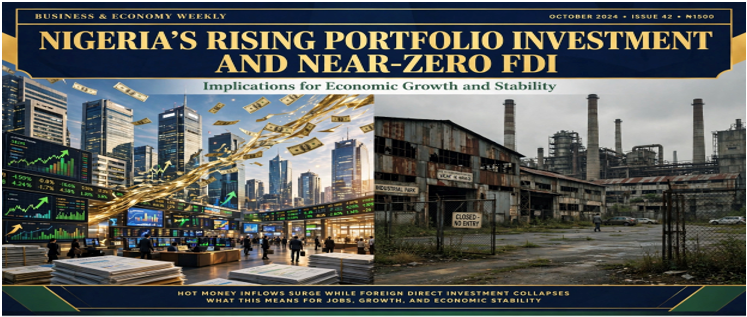
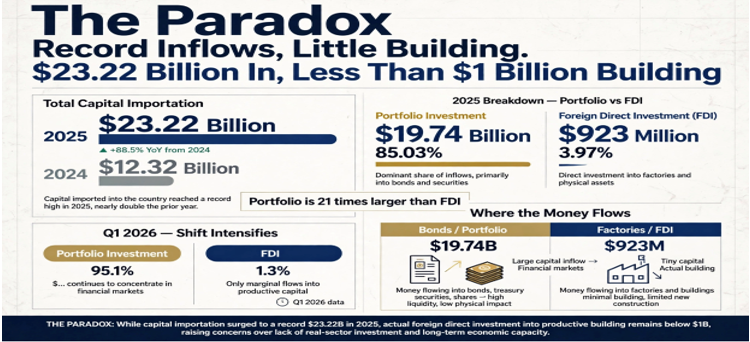
Nigeria is attracting more foreign money than at any time in the last decade and yet building fewer factories, fewer jobs, and fewer productive assets with it. That is the paradox at the heart of Nigeria’s capital story in 2025 and 2026. According to the National Bureau of Statistics (NBS), total capital importation into Nigeria surged to $23.22 billion in 2025, up sharply from $12.32 billion in 2024, an 88.5% increase. In Q1 2026 alone, capital importation hit $10.37 billion, the highest quarterly inflow since 2013, up 83.8% year-on-year. In the first five months of 2026, inflows reached $16.41 billion, more than double the $8.13 billion in the same period of 2025. On the surface, this looks like a vote of confidence in President Tinubu’s reforms: naira floatation, fuel subsidy removal, FX unification, and tight monetary policy. And in one sense, it is. But look beneath the headline and a dangerous imbalance emerges.
In 2025, Foreign Portfolio Investment (FPI), short-term money invested in stocks, bonds, and treasury bills, accounted for $19.74 billion, or 85.03% of total inflows, more than double the $8.38 billion in 2024. Foreign Direct Investment (FDI), long-term money invested in factories, businesses, infrastructure, and productive assets, accounted for just $923.01 million, or 3.97% of total inflows. In other words, for every $100 that entered Nigeria in 2025, $85 went into financial paper, and less than $4 went into building something real. Portfolio inflows were more than 21 times larger than FDI. By 2026, the imbalance has worsened. In Q1 2026, FPI accounted for 95.1% of inflows at $9.86 billion, while FDI was just $135.08 million, or 1.3% of inflows. In the first five months of 2026, FPI was $15.61 billion (95.12% of total), while FDI fell 9.5% year-on-year to just $190 million, more than 80 times smaller. This article explains why this pattern has emerged, what it means for growth, jobs, exchange rate stability, and fiscal sustainability, and what Nigeria must do to convert hot money into durable prosperity.
1. Why Portfolio Investment Is Surging: Yield, Reforms, and Confidence.
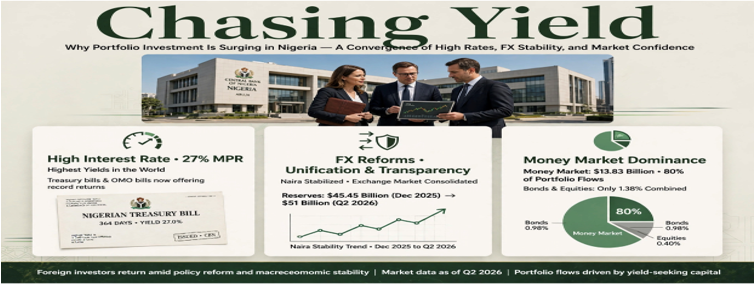
Portfolio investors are not investing in Nigeria out of charity. They are chasing yield. The Central Bank of Nigeria kept its Monetary Policy Rate at 27% for most of 2025 to fight inflation and stabilise the naira. That created some of the highest real yields in the world on Nigerian Treasury bills, OMO bills, and bonds. For a global fund manager in London or New York, Nigerian money market instruments offered returns that were impossible to find in the US or Europe. In 2025, money market instruments alone accounted for over 80% of total portfolio inflows at $13.83 billion. In Q1 2026, money market instruments attracted $6.50 billion (65.95% of portfolio inflows), and bonds attracted $3.23 billion (32.71%), while equities accounted for just 1.38%. FX reforms also mattered. The unification of the FX market, improved transparency, and narrowing of the gap between official and parallel rates restored confidence that investors could enter and exit Nigeria without being trapped. PwC’s Nigeria Economic Outlook 2026 attributed the rebound to “unification and increased transparency of the foreign exchange market, which reduced arbitrage opportunities and improved price discovery.” The result: external reserves rose to $45.45 billion by December 2025, and past $51 billion by Q2 2026. The naira appreciated by 6.9% year-on-year to N1,436.31/$ at the official market in 2025. Headline inflation fell for eight consecutive months to 14.45% in November 2025. In short, portfolio inflows have helped stabilise the macroeconomy. They should be acknowledged as a success of reform. But they are not a substitute for development.
2. Why FDI Is Near-Zero: The Real Economy Still Deters Long-Term Capital.
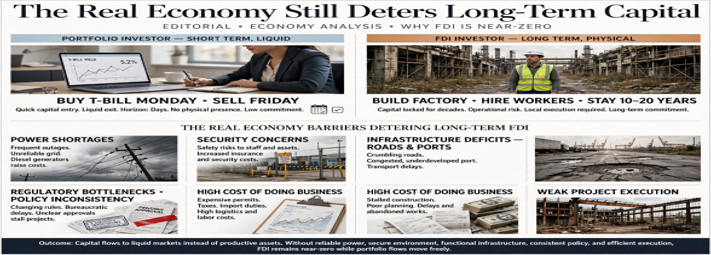
FDI is different from FPI. A portfolio investor can buy a T-bill on Monday and sell it on Friday. An FDI investor must build a factory, hire workers, secure land, get permits, connect to power, move goods on roads, and stay for 10 to 20 years. That investor asks harder questions, and Nigeria still gives worrying answers. PwC, Cowry Asset Management, and the World Bank point to the same structural barriers: security concerns, infrastructure deficits, regulatory bottlenecks, policy inconsistency, high cost of doing business, power shortages, and weak project execution. In 2025, FDI rose 36.8% in absolute terms to $923 million from $674.71 million in 2024, its highest level since 2020, but its share fell from 5.48% to 3.97%. In Q4 2025, FDI was $357.80 million, the strongest quarter of the year. Yet even that quarterly FDI was smaller than portfolio inflows in any single quarter of 2025.
Sectorally, the story is even starker. In Q4 2025, banking received 59.75% of total capital importation ($3.85 billion), financing received 30.15%, while production/manufacturing received just 4.79% ($308.93 million). The UK accounted for 58% of inflows, but most of that was portfolio money routed through London banks, not new factories. The World Bank’s Chief Economist, Indermit Gill, recently warned that FDI globally is plummeting to new lows at the same time public debt is reaching record highs. Nigeria is not immune to that global trend, but its own domestic constraints make it worse. Near-zero FDI means near-zero Greenfield investment. It means no new industrial parks, no new agro-processing plants at scale, no new technology transfer, no new export capacity.
3. The Implications for Economic Growth: Financial Growth without Productive Growth.
This is the most dangerous implication. Nigeria is experiencing financial inflows without productive transformation. FDI creates growth in a way FPI cannot. FDI builds factories that employ people for decades. It brings technology, management skills, and access to global markets. It creates backward linkages, local suppliers, logistics, packaging, and maintenance that create multiple jobs. It increases exports and reduces import dependence. FPI does none of that directly. It buys existing financial assets. It does not build a new plant. It does not train a worker. It does not transfer technology. As a result, Nigeria can have record capital importation and still have high unemployment, low manufacturing growth, and low productivity. GDP may grow on paper, driven by services, finance, and oil, but the growth is not inclusive. It does not create the mass jobs needed for a country with a median age of 18.1 and over 100 million young people entering the workforce by 2050. Cowry Asset Management warned in its review of FY 2025 data that Nigeria should focus on attracting “more durable, long-term capital” that supports long-term economic growth, because portfolio inflows “can reverse quickly in response to shifts in global risk appetite, geopolitical tensions, or tighter financial conditions abroad.”
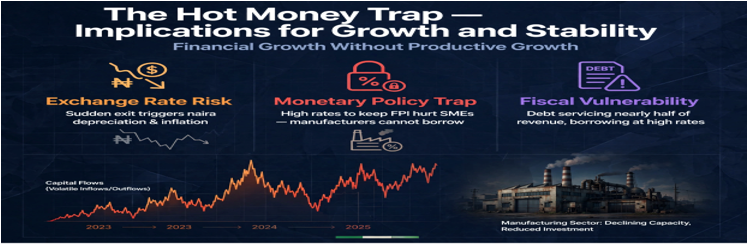
4. The Implications for Stability: The Hot Money Trap.
Portfolio investment is called “hot money” for a reason. It can leave as fast as it came. In the first five months of 2026, FPI volatility was clear: $3.37 billion in January, down 14.8% to $2.87 billion in February, up 26.1% to $3.62 billion in March, down 26.5% to $2.66 billion in April, up 16.2% to $3.09 billion in May. Total capital importation moves almost entirely with FPI because FPI is more than 90% of it. This creates three stability risks:
• First, exchange rate risk. If US interest rates rise, or global risk appetite falls, or oil prices drop, portfolio investors can exit Nigeria en masse. That would trigger naira depreciation, imported inflation, and reserve depletion, exactly the crisis Nigeria faced in 2023-2024. Nigeria’s reserves are stronger now, but they are built on reversible flows, not on export earnings or FDI.
• Second, the monetary policy trap. To keep portfolio investors, the CBN must keep interest rates high. But high rates hurt the real economy: they make borrowing expensive for Nigerian SMEs, manufacturers, and farmers. They crowd out domestic investment. Nigeria is in effect paying high interest to attract foreign money that does not build factories, while Nigerian businesses cannot afford to borrow to build factories. This is unsustainable.
• Third, fiscal vulnerability. PwC described debt servicing as Nigeria’s “key fiscal vulnerability,” noting that debt payments consumed nearly half of government revenue in 2025. High yields attract FPI, but they also increase the government’s borrowing cost. Nigeria is borrowing at high rates to fund deficits, and using portfolio inflows to finance that borrowing. It is a circular dependence.
5. The Implications for Jobs, Inclusion, and Sovereignty.
The FPI-FDI imbalance also has social and political implications. FDI is geographically dispersed — it can go to Kano, Kaduna, Aba, or Ogun. FPI is concentrated in Lagos and Abuja, in banking and finance. FPI benefits asset holders, those who own stocks and bonds. FDI benefits workers, those who get jobs in factories and farms. A growth model built on FPI therefore widens inequality. It enriches the financial sector while manufacturing and agriculture starve for capital. It creates a two-speed economy: a booming financial market and a struggling real economy. It also reduces economic sovereignty. When 95% of your foreign capital is portfolio money, your economy is hostage to decisions made in London, New York, and Frankfurt. A Fed rate hike or a global risk-off event can trigger capital flight that has nothing to do with Nigeria’s fundamentals.
6. What Must Change: From Hot Money to Patient Capital.
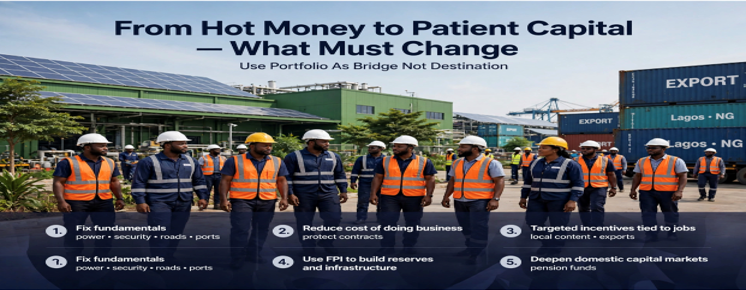
Nigeria does not need to reject portfolio investment. It needs to use it as a bridge, not a destination.
• First, fix the fundamentals for FDI: power, security, roads, ports, and predictable regulation. The Federal Ministry of Industry, Trade and Investment’s 2026 Outlook promises to deepen trade facilitation and tighten policy execution. That must translate into faster permits, reliable electricity for industrial clusters, and security for investors in the North and Middle Belt.
• Second, reduce the cost of doing business and protect contracts. Investors will not commit 20-year capital if they fear policy reversal, arbitrary taxes, or inability to repatriate profits.
• Third, create targeted incentives for productive FDI: tax incentives tied to jobs created, local content, and exports, not blanket waivers. Special Economic Zones with real infrastructure, not just on paper. Blended finance to de-risk infrastructure, agriculture, and manufacturing projects.
• Fourth, use FPI inflows to build reserves and fund infrastructure, not just to finance consumption and deficits. And gradually normalise interest rates as inflation falls, so domestic businesses can borrow and grow. Fifth, deepen domestic capital markets so Nigerian pension funds and insurers can fund long-term projects, reducing dependence on foreign hot money.
CONCLUSION
Nigeria’s rising portfolio investment is both a success and a warning. It is a success because it shows that reforms have restored a measure of confidence, stabilised the naira, rebuilt reserves, and brought Nigeria back to global capital markets. It is a warning because confidence in financial markets is not the same as confidence in the real economy. When 95% of your capital is hot money and less than 2% is FDI, you have not yet built the foundation for durable growth. Economic growth that is driven by portfolio flows is fragile growth. It can reverse in a week. Economic stability built on portfolio flows is fragile stability. It depends on the mood of foreign fund managers. True stability and true growth will come when a foreign investor chooses to build a factory in Ogun, not just buy a T-bill in Lagos. When a global company chooses to process minerals in Nigeria, not just trade Nigerian bonds. When capital creates jobs, transfers technology, and builds exports — not just yields. Nigeria has the market, the people, and the reform momentum. The next step is to convert the confidence of portfolio investors into the commitment of direct investors. If we do that, the $23 billion of 2025 will not be remembered as a peak of hot money, but as the beginning of a new era of inclusive, productive, and sustainable growth. If we do not, we will remain vulnerable, a country that attracts money but does not build wealth. The choice is ours.
Key Data Sources: NBS Capital Importation Reports 2025 & Q1 2026, CBN Monthly Economic Reports Jan-May 2026, PwC Nigeria Economic Outlook 2026, Cowry Asset Management FY 2025 Review.
For more information, clarifications and support, Contact Prof. Prisca Ndu on +2348033086190 or [email protected]
Related News

Dr. Prisca Ndu who holds four doctorate degrees in Credit Management, Banking and Finance, Leadership and Management and Artificial Intelligence, is a social impact advocate and multi-sector entrepreneur. An alumnus of the University of Ibadan, Lagos Business School, Harvard Business School, London Graduate School, Institute of Management Development, INSEAD and Robert Kennedy College, Switzerland, amongst others. She sits on the Board of several companies including INDECO, KREENO Consortium, BHLA Awards, and many more. She was listed in 2017 among the most influential people of African descent by the United Nations and is passionate about Nation Building.


Source: