By Steve Oko, Regional Editor, South East
The scene at the School of Health Aba, the commercial capital of Abia State last weekend offered a fascinating glimpse into what could become one of the defining political contradictions of the 2027 presidential election. It showed the widening gulf between the political calculations of South East power brokers and the apparent preferences of the ordinary people.
It was a moment when political establishment encountered popular sentiment, and the response from the crowd was anything but pretence. The masses, in unmistakable terms, passed a strong message: they are not in for jokes! They know what is good for them.
While a significant section of the South East political establishment, including governors, National Assembly members and other influential politicians, has either openly or tacitly aligned with President Bola Ahmed Tinubu’s re-election ambition, the grassroots appear to be gravitating in a different direction, with the former Anambra State governor, and the Nigeria Democratic Congress, NDC, flag bearer, Mr Peter Obi, retaining a formidable following across the region.
The drama unfolded when Deputy Speaker of the House of Representatives, Rt. Hon. Benjamin Kalu, attended the 2026 Item Day organised by the Item people in Aba. Kalu hails from Bende town, a neighbouring community with Item. As a prominent supporter of President Tinubu, Kalu apparently saw the gathering as an opportunity to canvass support for the President ahead of 2027. He never wanted to miss the opportunity, and rightly so.
But what followed was a political moment he might not have anticipated. He never dreamed of the dramatic turn of events as he grabbed the microphone to market Tinubu’s candidacy.
Dressed in the traditional Igbo (isiagu) attire, with a red cap to match, Kalu who prides himself as ‘the number six’ man in the country, mounted the stage and urged the people to support Tinubu’s re-election, assuring them that the President would do more for Abia if given another mandate.
“Tinubu will do more for Abia. Vote for Tinubu in 2027. He is the best for Nigeria,” he told the gathering.
But as the Deputy Speaker shouted “Tinubu”, apparently expecting an enthusiastic response from the crowd, what came back was a thunderous rendition of “Obi kererenke”, the popular solidarity chant associated with Peter Obi. The response was spontaneous, collective and blunt!
Even with a microphone, Kalu’s voice appeared drowned by the surging chants of the crowd. Attempts to calm the gathering did little to change the mood. Neither his assurance of a proposed federal university for Item nor the intervention of a performing artiste, who quickly introduced another Tinubu campaign song, “On Your Mandate We Shall Stand”, could dislodge the crowd’s enthusiasm for Obi.
The Obi chants persisted, leaving the Deputy Speaker visibly taken aback. At a point, he wondered whether the people before him were genuinely Item indigenes.
But his question over the true identity of the crowd, perhaps, was more rhetorical than practical. It was a community thing and there was no mixed audience as the people could easily identify themselves. There was little reason to suggest any infiltration or invasion by outsiders.
Apparently sensing the mood, Kalu eventually abandoned the political solicitation, bringing an unexpected end to what was meant to be a campaign opportunity. A video of the incident has since circulated widely on social media, generating conversations about the actual reach of the South-East political establishment among its constituents. Beyond the embarrassment or amusement the episode may have generated, it raises a more consequential question: Can the political elite deliver the South East electorate to a presidential candidate whose popularity among ordinary voters appears considerably weaker than the influence of those championing his cause?
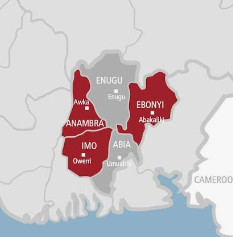
The South East presents an interesting political paradox. With the recent defection of Gov. Peter Mbah of Enugu State to the APC, the APC now controls three out of five states in the zone – Imo, Enugu and Ebonyi states, while Anambra is governed by the APGA which has formally endorsed Tinubu. The governors of these states have various degrees of political alignment with the Tinubu administration, with several influential politicians from the region also playing prominent roles in the President’s political calculations.
Even Abia Governor, Dr Alex Otti, who shared a political platform with Obi in 2023, has, on several occasions, avoided positioning himself as an opponent of Tinubu’s re-election bid. Otti has also not openly canvassed support for Obi.
Yet, the apparent enthusiasm for Obi among sections of the grassroots suggests that political alignment at the top may not necessarily translate into electoral compliance at the bottom.
There are several reasons this disconnect may persist. And dismissing these underlying factors with a wave of the hand is politically suicidal.
First is Obi’s enduring appeal, built around his reputation for prudence in public finance, perceived administrative discipline, personal integrity and the promise of a different approach to governance.
Whether his supporters’ expectations can be translated into electoral victory is another matter, but his emotional connection with a significant section of the South East electorate remains a political factor that cannot be wished away.
There is also the unresolved Nnamdi Kanu question. The continued detention of the Indigenous People of Biafra (IPoB) leader remains a sensitive issue in the region. Many residents view his incarceration as unjustified and have continued to appeal for his release. For such people, the Federal Government’s handling of the matter has become an important measure of its disposition towards the South East.
Many are still struggling to understand the justification behind Kanu’s continued incarceration at a time bandits and mass murderers are enjoying state pardon under the guise of repentance. Yes, Kanu was not arrested and renditioned under Tinubu but he was sentenced to life imprisonment under him. And for one year his efforts to appeal his conviction have continued to suffer inexplicable setbacks.
Consequently, assurances by political office holders from the region that the APC government has the South East at heart may not be enough to erase the reservations of voters who believe that more decisive action should have been taken on Kanu’s case.
Infrastructure and economic inclusion are other issues shaping public perception. The prolonged neglect of the Eastern railway corridor, particularly the failure to restore regular train services along the route since 2015, remains a source of concern. This is especially so against the backdrop of federal investments in railway infrastructure in other zones oy the country.
The removal of sections of the old railway tracks in the region in anticipation of rehabilitation and replacement, has further heightened concerns among residents who are yet to see the promised transformation.
There is also the broader question of equity in the distribution of political power and national opportunities.
Nearly six decades after the Nigerian Civil War, the South East is yet to produce a democratically elected president. For many in the region, this remains an uncomfortable symbol of their perceived exclusion from the highest level of national political leadership.
While political office holders may consider strategic alignment with the centre even at the expense of their people a practical route to securing federal attention and influence, ordinary voters may see the matter differently. Their expectations are not necessarily limited to access to the corridors of power; they also include fairness, recognition, infrastructure and a sense of belonging.
To be fair, the South East’s experience under successive administrations cannot be reduced to the policies of one political party. Nor can every development challenge in the region be blamed exclusively on the current Federal Government. However, perceptions, whether entirely justified or otherwise, often carry considerable weight in electoral politics.
The Item Day incident may not necessarily represent the opinion of every South East voter, and a spontaneous crowd reaction at a cultural festival cannot substitute for the verdict of the ballot box. But it offers a revealing indication that the political preferences of the grassroots should not be taken for granted.
The 2027 election may therefore test not just the strength of the APC’s political structure in the South East but also the ability of its influential political figures to persuade their constituents to embrace a presidential project they appear less enthusiastic about.
The political elite are entitled to their choices, just as the masses are entitled to theirs. Neither political office nor proximity to power confers ownership of the electorate’s conscience.
Ultimately, the 2027 presidential election will not be decided by endorsements, political calculations, campaign songs or the number of influential personalities standing behind a candidate. It will be decided by voters, one ballot at a time.
The South East political establishment may have its preferred presidential destination, but the grassroots appear determined to have a say in choosing their own route. The masses are beginning to prove that they, not the elite, are ‘the lion of the South East’.
Whether that mood will survive the pressures, negotiations and realignments of the campaign season remains to be seen. One thing, however, is increasingly clear: no political party should mistake the support of the elite for an automatic endorsement by the people!
The post 2027: Presidential choice exposes widening elite – grassroots divide in S’East appeared first on Vanguard News.
Source: