…Consumer purchasing power continues to shrink as prices increase

Nigerian consumers are paying more for food and beverage products despite easing inflation, as the cumulative impact of previous price increases continues to erode household purchasing power, while their profitability and operating cash generation improve.
An analysis of the nine-month financial statements of 11 consumer goods companies listed on the Nigerian Exchange (NGX) shows that aggregate cash generated from operating activities more than doubled to N1.47 trillion in the nine months ended September 2026, from N698.3 billion in the corresponding period of 2025.
The surveyed manufacturers include BUA Foods, Cadbury Nigeria, Champion Breweries, Dangote Sugar Refinery, Guinness Nigeria, International Breweries, McNichols, NASCON Allied Industries, Nestle Nigeria, Nigerian Breweries, and Unilever Nigeria.
Operating cash flow is particularly important because it measures the cash generated from a company’s core operations after accounting for working capital movements. Unlike accounting profit, it provides an indication of the resources available to support production, meet obligations, invest in operations, and reduce dependence on external financing.
Consumer goods manufacturers were forced to raise prices to stay afloat amid soaring costs of raw materials, energy, packaging, logistics and foreign exchange, passing a significant portion of the higher production costs on to consumers already struggling with declining purchasing power.
The price adjustments, alongside tighter cost controls and improved working capital management, helped strengthen operating cash generation at companies such as BUA Foods, Nigerian Breweries, International Breweries, and Dangote Sugar, although the resulting higher product prices continued to constrain demand and limit broader revenue growth.
Their combined profit after tax also increased by 30.2 percent to N905.11 billion from N695.32 billion, indicating a substantial improvement in earnings across the sector.
However, the improvement in profitability has not been matched by revenue growth. Combined revenue declined marginally by 0.8 percent to N5.16 trillion from N5.20 trillion, exposing the growing disconnect between manufacturers’ financial performance and the spending capacity of Nigerian consumers.
The improvement in corporate performance comes against a backdrop of easing inflation, greater foreign exchange stability and renewed optimism among manufacturers.
Nigeria’s headline inflation moderated for the fifth consecutive month to 14.06 percent in October 2026, from 14.63 percent in September and 18.97 percent in October 2025, according to the National Bureau of Statistics.
Food inflation also eased to 19.13 percent from 19.59 percent in September, providing some relief to households and food manufacturers whose operations depend heavily on agricultural commodities and imported production inputs.
The Central Bank of Nigeria’s October 2026 Purchasing Managers’ Index also showed that private-sector business activity remained in expansion territory at 53.2 points, compared with 53 points in September.
Within the industrial sector, the manufacturing activity index increased to 52.6 points from 52 points, its third consecutive month of expansion.
For consumer goods manufacturers, this matters because exchange rate predictability improves the ability to forecast the cost of imported raw materials, machinery, packaging materials, and production inputs. Slower inflation also reduces the frequency of price adjustments and allows companies to plan inventory and procurement more efficiently.
The improvement is reflected in manufacturers’ confidence. The Manufacturers Association of Nigeria’s (MAN) Manufacturers’ CEO Confidence Index rose to 52.1 points in the second quarter of 2026 from 48.7 points in the first quarter, crossing the 50-point threshold that separates optimism from pessimism.
The reading was the highest in more than two years, signalling renewed confidence among manufacturing executives about the direction of the economy and the potential impact of government policies.
However, the improvement in confidence was driven largely by expectations of better business conditions rather than a complete resolution of existing operational challenges.
Manufacturers continued to contend with high financing costs, electricity expenses, infrastructure deficiencies and difficulties accessing affordable credit.
Read also: Emefiele: Witness say CBN bypassed board, altered Buhari-approved naira redesign
Weak purchasing power continues to constrain demand
According to the Nigeria Bureau of Statistics (NBS), manufacturers’ investment hit N4.5 trillion in 2025. However, it also disclosed that weak demand left N2.1 trillion goods in warehouses.
The body also disclosed that the increase in manufacturing sector investment in 2025 was wiped out by a disquieting accumulation of unsold goods as declining consumer purchasing power weakened demand.
Saviour Iche, the national president of the National President and founder of the Association of Micro-Entrepreneurs of Nigeria (AMEN), said that the warehouses are full of unsold goods and products because Nigerians do not have the money to buy them.
“When people do not have enough money to spend, manufacturers face lower demand, reduced revenue, and difficulties sustaining their businesses. When consumers cannot afford products such as clothing, beverages, furniture, packaged foods, and household appliances, they reduce their purchases or switch to cheaper alternatives. As a result, Nigerian manufacturers sell fewer products, leading to lower turnover and reduced profitability.”
Despite successive minimum wage increases, from N18,000 in 2015 to N70,000 in 2024, the cost of essential goods and services has outpaced income growth for many Nigerians, leaving a monthly salary able to buy about 50 litres of fuel, down from 84.
The World Bank said in April that household incomes have not grown fast enough to offset still-elevated inflation, and it does not expect poverty to fall to 59 percent until 2028.
Costs are creeping back for companies too. Distribution expenses rose 29 percent at Nigerian Breweries and 20 percent at Guinness as fuel prices climbed, staff costs.
The CBN retained the benchmark interest rate at 23 percent, citing inflationary risks arising from anticipated election-related spending, increased festive season expenditure and disruptions to global energy supplies.
Cash generation becomes the strongest indicator of recovery
The most significant development in the nine-month results is the improvement in operating cash flow.
Combined operating cash generated by the 11 companies increased by 110.7 percent to N1.47 trillion, significantly exceeding the 30.2 percent growth in profit after tax.
BUA Foods accounted for the largest contribution, generating N685.75 billion in operating cash compared with N324.82 billion in the corresponding period of 2025.
International Breweries recorded the second-fastest growth in operating cash flow among the companies with positive comparative figures, increasing by 235.6 percent to N114.43 billion from N34.10 billion.
Dangote Sugar Refinery recorded an even more dramatic turnaround, moving from negative operating cash flow of N73.41 billion to positive N211.28 billion.
NASCON Allied Industries increased operating cash flow by 32.9 percent to N32.14 billion from N24.17 billion. Champion Breweries recorded a 49.4 percent increase in operating cash flow to N8.54 billion from N5.71 billion.
Cadbury Nigeria recorded a 26.8 percent increase in operating cash flow to N5.66 billion from N4.47 billion.McNichols Consolidated recorded a 56.8 percent increase in operating cash flow to N734 million from N468 million, and Nigerian Breweries’ operating cash increased to N150.03 billion from N61.18 billion.
Thibaut Boidin, managing director of Nigerian Breweries, said despite some stability in the macroeconomic environment, consumer disposable income remained constrained, although the company recorded a strong performance in the first nine months of 2026.
Read also: Nigeria’s metering gap narrows to 4.56m as DisCos connect 1.27m customers in 10 months
“The company strengthened its financial position through robust cash generation and improved working capital management, which improved its net cash position and provided a stronger foundation to fund business priorities and support sustainable growth.”
Nevertheless, the improvement was not universal. Nestlé Nigeria’s operating cash flow declined to N210.62 billion from N248.41 billion, while Guinness Nigeria recorded a fall to N51.56 billion from N62 billion.
Unilever Nigeria experienced a sharper contraction, with operating cash generation dropping to N242 million from N6.37 billion.
Profitability improves despite weak revenue growth
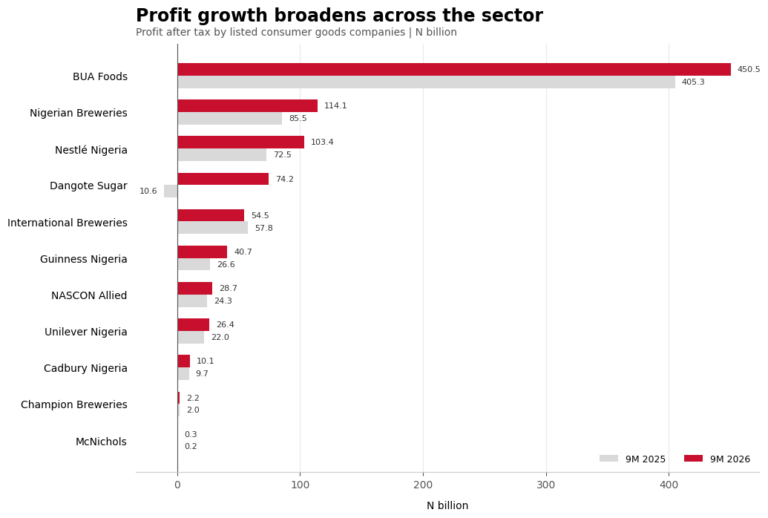
While cash generation provides evidence of improved financial discipline, the sector’s earnings performance also points to a gradual recovery in profitability.
BUA Foods remained the largest profit contributor, recording N450.47 billion in profit after tax, up from N405.27 billion.
Nigerian Breweries followed with N114.10 billion, compared with N85.51 billion, while Nestlé Nigeria increased profit to N103.37 billion from N72.48 billion.
Dangote Sugar returned to profitability with N74.25 billion, reversing a loss of N10.59 billion in the previous year.
Guinness Nigeria also recorded a 53.1 percent increase in profit after tax to N40.69 billion from N26.59 billion, while Unilever Nigeria’s profit increased to N26.40 billion from N21.98 billion.
The improvement across several companies suggests that manufacturers are beginning to benefit from better cost control, operational efficiency, and more favourable input-cost conditions.
However, International Breweries’ profit declined to N54.51 billion from N57.83 billion despite an increase in revenue, showing that cost pressures remain significant for some businesses.
Aderemi Saka, managing director of NASCON Allied Industries, said improved operational efficiency and disciplined cost management supported the company’s profitability despite a challenging business environment.
“While revenue remained stable at N116.9 billion compared to prior year, improved operational efficiency and disciplined cost management enabled us to achieve stronger profitability and margin expansion,” she said.
She added that the company would continue to focus on operational excellence, strengthening its position in the salt and seasoning market and optimising its route-to-market strategy to sustain profitable growth.
NASCON’s financial results reflect this strategy, with profit after tax increasing to N28.70 billion from N24.33 billion, despite revenue remaining broadly unchanged.

Chinwe Michael is a Nigerian business journalist and media professional with over 4 years of experience covering companies, financial markets,…


Source: