…Côte d’Ivoire, DRC joins six others in exit lists since October 2025
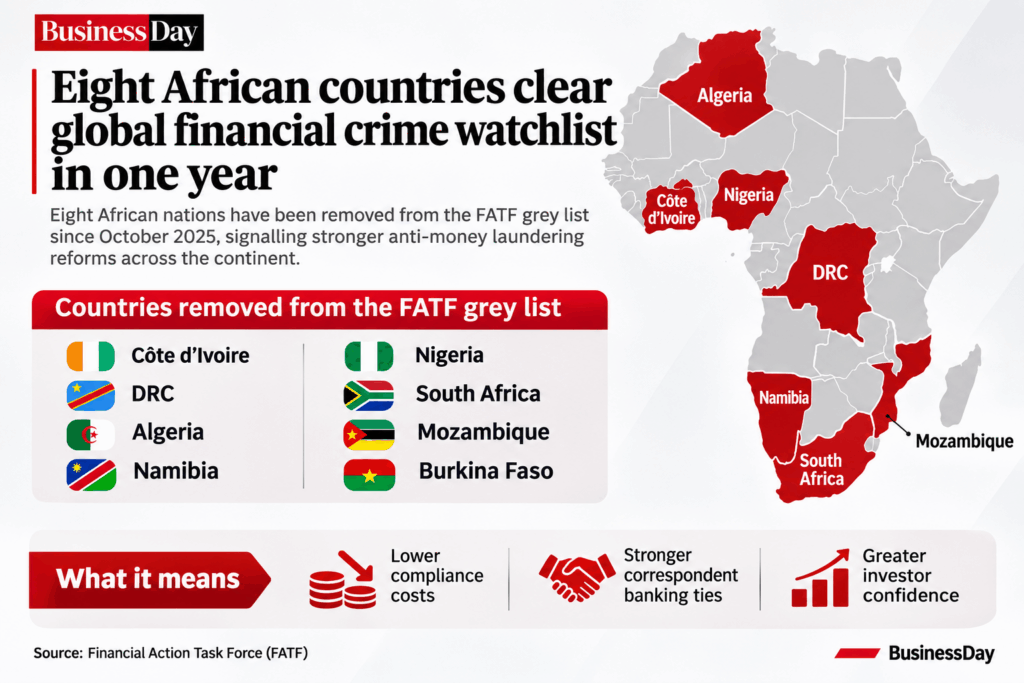
Eight African countries have exited the global financial crime watchlist in the past year, marking a significant improvement in the continent’s efforts to strengthen anti-money laundering controls and restore confidence among international investors and financial institutions.
The latest removals came on Friday, when the Financial Action Task Force (FATF), the world’s leading financial crime watchdog, removed Côte d’Ivoire and the Democratic Republic of Congo (DRC) from its grey list, bringing the number of African countries cleared since October 2025 to eight.
These exits extend a wave of progress that has also seen Algeria, Namibia, Nigeria, South Africa, Mozambique and Burkina Faso strengthen their safeguards against money laundering and terrorist financing, improving their standing with international lenders, investors and correspondent banks. The progress comes as African countries compete for global capital amid rising geopolitical uncertainty and tighter international scrutiny of illicit financial flows.
The decisions followed progress by both countries in addressing weaknesses in their anti-money laundering and counter-terrorist financing (AML/CFT) frameworks. FATF said they had successfully addressed strategic deficiencies identified during earlier evaluations.
The DRC’s removal follows four years of reforms after it was placed on the grey list in October 2022. According to FATF, the country completed all 23 actions outlined in its reform plan.
The reforms covered several areas of the country’s financial crime prevention framework, including strengthening legal and regulatory structures, improving risk-based supervision, enhancing the performance of its national financial intelligence unit, CENAREF, and increasing investigations and prosecutions of financial crimes.
In its report, FATF said the DRC had strengthened the effectiveness of its AML/CFT regime by finalising its national risk assessment on money laundering and terrorist financing and adopting a national strategy to address identified deficiencies.
Other measures included designating supervisory authorities for all designated non-financial businesses and professions, adequately resourcing the financial intelligence unit, improving the capacity of law enforcement agencies and strengthening the implementation of targeted financial sanctions.
Congolese Finance Minister Doudou Roussel Fwamba Likunde Li-Botayi described the decision as a milestone for the country’s financial system and international credibility.
“This is a milestone for the integrity of our financial system and for the credibility of the Democratic Republic of the Congo,” he said in a statement.
He added that removal from the list was expected to reduce the cost and friction associated with cross-border transactions for Congolese banks, businesses and citizens, while supporting correspondent banking relationships and strengthening confidence among investors and international partners.
Côte d’Ivoire, which was placed on the FATF grey list in October 2024, also secured removal after implementing reforms to address weaknesses in its systems for combating money laundering, terrorist financing and the proliferation of weapons.
The West African country committed to addressing the deficiencies through an action plan agreed with FATF and the Intergovernmental Action Group against Money Laundering in West Africa (GIABA).
Last June, FATF had acknowledged that the country had completed most of its action plan, although an on-site assessment was still required to verify the sustainable implementation of reforms.
The improvements included stronger oversight of financial institutions, better access to information on the beneficial owners of companies and increased use of financial intelligence by investigators. The watchdog also noted a sustained increase in investigations and prosecutions relating to money laundering and terrorist financing.
In its latest assessment, FATF said Côte d’Ivoire had strengthened international cooperation in financial crime investigations and prosecutions, improved risk-based supervision of financial institutions and non-financial businesses, and conducted outreach campaigns to improve compliance.
The country also improved access to beneficial ownership information, strengthened the use of financial intelligence by law enforcement agencies and enhanced its framework for implementing targeted financial sanctions.
Countries on the FATF grey list are subject to increased monitoring because of weaknesses in their anti-money laundering and counter-terrorist financing systems. Although grey-listing does not automatically trigger sanctions, it can increase compliance costs, complicate correspondent banking relationships and make it more difficult for businesses and governments to access international finance.
The list currently contains 18 jurisdictions under increased monitoring, including four African countries: Angola, Cameroon, Kenya and South Sudan.
Nigeria and South Africa lead Africa’s FATF turnaround
The latest removals follow the exits of Nigeria and South Africa from the FATF grey list last year October.
Africa’s two largest economies implemented extensive reforms to strengthen anti-money laundering controls, improve financial intelligence sharing, increase beneficial ownership transparency and tighten regulatory oversight.
South Africa addressed 22 action items agreed with FATF through legislative reforms, stronger law enforcement coordination, enhanced tax and border controls and tougher supervisory penalties for non-compliant institutions.
Nigeria, which was added to the grey list in February 2023, strengthened its anti-money laundering framework through new legislation, enhanced supervision of high-risk sectors, improved financial intelligence capabilities and increased enforcement against financial crimes.
Mozambique and Burkina Faso also exited the list in 2025 after implementing extensive reforms to strengthen anti-money laundering controls, improve beneficial ownership transparency, enhance financial sector supervision and increase financial crime investigations.
Mozambique had been under increased monitoring since October 2022, while Burkina Faso entered the list in February 2021.
Algeria’s removal represented a turnaround for the North African country, which was re-added to the FATF grey list in October 2024 after previously exiting in 2016.
To secure its latest removal, the country implemented reforms aimed at strengthening beneficial ownership transparency, improving oversight of financial and non-financial sectors, increasing transparency in cross-border financial flows and enhancing the detection of suspicious transactions.
According to Abderrahmane Mebtoul, former director-general of economic studies, the reforms were underpinned by legal and institutional changes introduced since 2023, including amendments to the country’s anti-money laundering framework and stronger compliance requirements for banks and financial institutions.
The authorities also accelerated the implementation of a National Register of Beneficial Owners and introduced stricter customer due diligence and transaction monitoring requirements.
The reforms are expected to strengthen Algeria’s financial credibility, improve relationships with international banking partners and enhance its attractiveness to foreign investors.
Namibia, which was placed on the FATF grey list in February 2024 after the watchdog identified 13 strategic deficiencies in its anti-money laundering and counter-terrorist financing framework, also secured removal after addressing all 13 deficiencies.
The Southern African nation was cleared following a positive on-site assessment by FATF. According to the country’s finance ministry, the reforms strengthened Namibia’s ability to detect, investigate and prevent financial crimes while improving regulatory oversight.
The removal is expected to lower compliance costs, improve access to international finance and strengthen investor confidence in the country, Africa’s largest producer of uranium.
The eight exits highlight a broader trend of African countries strengthening financial governance frameworks to meet international standards and improve access to global capital.
However, with Angola, Cameroon, Kenya and South Sudan still under increased monitoring, the continent’s progress remains uneven. Sustaining the reforms and demonstrating effective enforcement will be critical to ensuring that recent improvements translate into stronger financial credibility and deeper integration with global financial markets.
Related News

Bunmi holds a degree in Economics from the University of Lagos and has over eight years of experience in content writing and journalism.
Her career spans roles as a financial and business journalist at BusinessDay Media and TechCabal, and as Head of Research at SBM Intelligence, an Africa-focused market intelligence and strategic consulting firm.
She also served as Editor at Finance in Africa, a subsidiary of Businessfront and is currently Assistant Editor, Finance (Africa), at BusinessDay.


Source: