Africa’s financial landscape is facing a fresh mix of trade uncertainty, monetary policy challenges, debt scrutiny, and shifting investment flows.
From Washington’s decision to withdraw trade benefits from South Africa and Rwanda to Ethiopia’s fight against inflation and Kenya’s return to foreign investor buying, this week’s developments highlight the economic pressures and opportunities shaping the continent.
Meanwhile, African countries are making progress in financial transparency, even as Nigeria faces renewed questions about public borrowing accountability.
Here are the stories shaping the first week of November.
AGOA suspension threatens South Africa, Rwanda’s US trade access
The United States’ decision to suspend South Africa and Rwanda from its preferential trade programme for African countries marks a further deterioration in relations between Washington and two governments whose foreign and domestic policies have increasingly clashed with President Donald Trump’s administration.
Announced on Monday by Jamieson Greer, US Trade Representative, the move will take effect on January 1, 2027, removing both countries from the African Growth and Opportunity Act (AGOA), which provides eligible sub-Saharan African countries with duty-free access to thousands of products entering the US market.
Why it matters: Losing AGOA benefits could raise the cost of exporting to the US, weaken the competitiveness of South African and Rwandan products and threaten export earnings, jobs and investment in affected industries.
Ethiopia holds interest rate at 16% despite rising money supply
Ethiopia’s central bank has maintained its benchmark interest rate at 16 percent despite a sharp acceleration in money supply growth, warning that inflation could remain in double digits for at least another six months.
The National Bank of Ethiopia (NBE) retained its policy rate following its eighth Monetary Policy Committee meeting on Monday, keeping the interest rate corridor 300 basis points above and below the benchmark. Annual inflation stood at 14.9 percent in September, while non-food inflation reached 15.1 percent, reflecting higher electricity tariffs, fuel costs and other household expenses.
Why it matters: Persistent inflation and accelerating money supply growth could complicate Ethiopia’s monetary tightening efforts, putting pressure on household purchasing power and the central bank’s ability to stabilise prices.
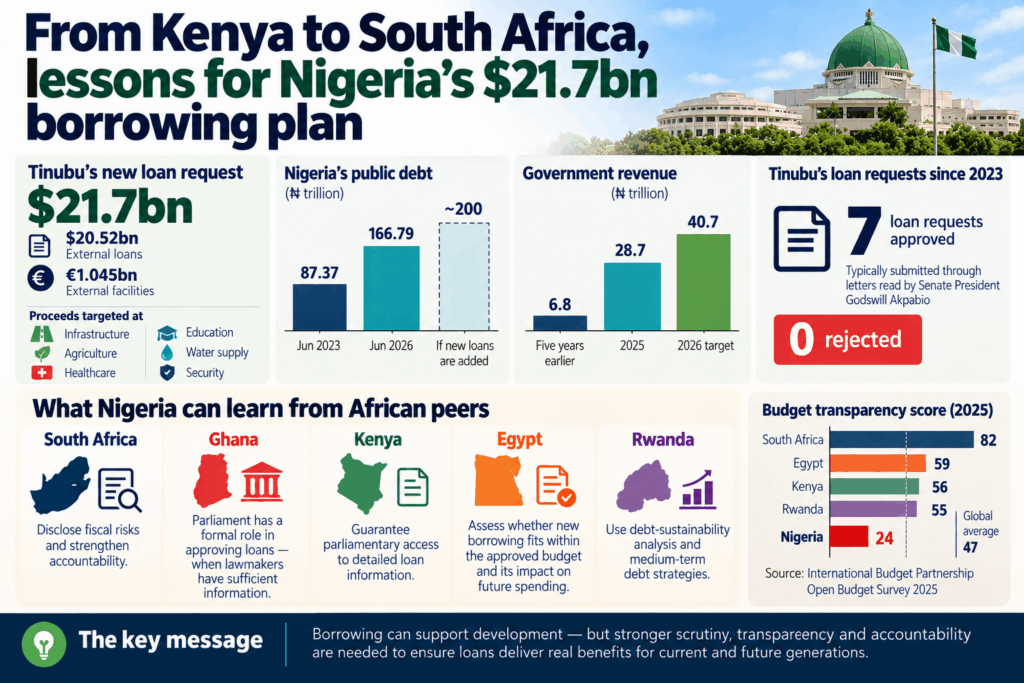
African peers expose gaps in Nigeria’s $21.7bn borrowing plan
Nigeria’s proposed $21.7 billion external borrowing plan has renewed concerns about weak scrutiny of public debt, particularly the absence of detailed information on the projects to be financed, their expected economic returns and repayment obligations.
The proposal presents an opportunity for Africa’s most populous economy to strengthen its borrowing framework by adopting practices from countries with clearer procedures for parliamentary approval, public disclosure of loan terms and monitoring of government financial obligations.
Why it matters: Without greater transparency on how borrowed funds are deployed and repaid, Nigeria risks accumulating debt without corresponding economic returns. Stronger disclosure requirements could improve public accountability, investor confidence and the productive use of borrowed capital.
Eight African countries exit global financial crime watchlist in one year
Eight African countries have exited the global financial crime watchlist in the past year, marking significant progress in the continent’s efforts to strengthen anti-money laundering controls and restore confidence among international investors and financial institutions.
The latest removals came on Friday, when the Financial Action Task Force (FATF), the world’s leading financial crime watchdog, removed Côte d’Ivoire and the Democratic Republic of Congo (DRC) from its grey list, bringing the number of African countries cleared since October 2025 to eight.
Why it matters: Exiting the FATF grey list can reduce compliance burdens, improve correspondent banking relationships and strengthen access to international financial networks. The progress also signals improvements in Africa’s financial governance, although four countries — Angola, Cameroon, Kenya and South Sudan — remain under increased monitoring.
Dangote-linked deal puts Nairobi bourse on track for first foreign inflows since 2019
Kenya’s stock market is heading for its first annual net foreign investor inflows since 2019 after a multibillion-shilling transaction involving Aliko Dangote’s investment in Kenya Pipeline Company (KPC) reversed months of foreign capital withdrawals.
Foreign investors recorded net purchases of KSh38.3 billion in October, ending nine consecutive months of net selling on the Nairobi Securities Exchange (NSE). A block trade involving KPC on October 19 drove the turnaround, accounting for KSh42.47 billion in reported net foreign purchases, according to The Kenyan Wall Street.
Why it matters: The reversal could signal renewed foreign investor appetite for Kenyan equities after years of capital outflows. However, the extent to which the market can sustain the recovery will depend on whether foreign buying broadens beyond the KPC transaction.
Related News

Bunmi holds a degree in Economics from the University of Lagos and has over eight years of experience in content writing and journalism.
Her career spans roles as a financial and business journalist at BusinessDay Media and TechCabal, and as Head of Research at SBM Intelligence, an Africa-focused market intelligence and strategic consulting firm.
She also served as Editor at Finance in Africa, a subsidiary of Businessfront and is currently Assistant Editor, Finance (Africa), at BusinessDay.


Source: