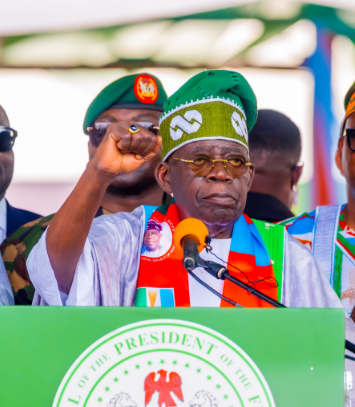
By Omeiza Ajayi
ABUJA – President Bola Tinubu goes into the January 16, 2027 presidential election with 31 governors from the All Progressives Congress, APC, as well as three from the “opposition”, a run of off-season victories and an opposition split across multiple platforms.
Read Also:
*2027: Why Peter Obi could win presidential election
*2027: Why Atiku could win presidential election
These are advantages that may carry him to a second term, even though living standards for millions have crumbled under his reforms.
He faces Atiku Abubakar of the African Democratic Congress, ADC; Peter Obi of the Nigeria Democratic Congress, NDC, and Seyi Makinde of the Allied Peoples Movement, APM. These are among 18 candidates on the Independent National Electoral Commission, INEC final list.
Kashim Shettima, a fellow Muslim, is again his running mate.
Cost of living crisis
The pain is measurable. The World Bank says the immediate effects of subsidy removal and exchange rate adjustment were a sharp rise in the cost of living, hitting poor and vulnerable households hardest. Subsidy removal pushed up transport and logistics costs, while the floating of the naira triggered depreciation and costlier imports.
Petrol is about six times higher than before the subsidy ended, and the World Bank puts poverty at just over half the population last year, up from about 42 per cent in 2022. Development partners say more than 31.8 million Nigerians face acute food insecurity. Food accounts for over 60 per cent of consumption among low-income households.
Borrowing has also grown. Public debt rose from N87.38 trillion in June 2023 to N166.79 trillion in June 2026, about 90.9 per cent higher. External debt climbed from about $43.1 billion to about $54.5 billion. The NDC has criticised a proposed N10.79 trillion external loan.
The government’s defence is that the reforms were unavoidable. Finance Minister Taiwo Oyedele said the country was living in “fiscal illusions.” The International Monetary Fund IMF has called subsidy removal one of Nigeria’s most important macroeconomic reforms.
The numbers are also moving in his favour. Headline inflation fell to 14.63 per cent in September 2026, its fourth straight monthly decline, and the naira strengthened to N1,333 per dollar in mid-October. External reserves have climbed to $55.07 billion. Even so, the central bank rate stands at 26.5 per cent, which keeps loans out of reach for many businesses.
Governors: More money, less accountability
The governors are both his greatest asset and a weakest spot. States and local governments have received a combined N31.77 trillion from the Federation Account Allocation Committee FAAC since the subsidy was removed. Civil society groups say the money has not translated into better infrastructure or services, and that governors still hold sway over council funds despite the Supreme Court’s 2024 autonomy judgment.
Tinubu has conceded the problem publicly. He recently told governors to “wet the ground” and deliver dividends of democracy at the grassroots. There is no sign that any consequence has followed.
31 govs and their worth
At least nine governors, among them those of Plateau, Kano, Delta, Enugu and Bayelsa, have crossed to the APC since 2023. The party says it now controls about 31 governors, up from about 22 in the last cycle, and is targeting at least 20 states. It also holds 89 senators and 282 House members. Three opposition governors have also declared support for his second-term bid.
Critics call this a drift towards a one-party state. Tinubu has rejected the accusation and urged his party to bring in more defectors.
The governors’ value at the ballot box is less certain. Analysts note that the number of governors backing a candidate does not directly measure his popularity. Allies have set a target of 18.7 million votes, against the roughly 8.79 million he won in 2023. Whether the 31 are genuinely loyal is also in question, and Federal Capital Territory FCT minister Nyesom Wike’s separate coalition is already feuding with them.
Off-season results: a mixed scorecard
The APC can point to several wins. In Ekiti, Governor Biodun Oyebanji became the first governor to win back-to-back re-election, and the party took five of six by-elections. It also won five of the six Federal Capital Territory FCT area councils in February. One tally says the APC has won five of eight off-cycle governorship elections since Tinubu took office, plus 15 of 19 National Assembly by-elections.
But the biggest recent test went the other way. In Osun, Governor Ademola Adeleke of the Accord Pbeat the APC candidate by 66,252 votes, 511,067 to 444,815. The loss came in the South-West, Tinubu’s home zone, and Adeleke had earlier declared support for Tinubu’s re-election. In Anambra, Governor Charles Soludo of the All Progressives Grand Alliance won all 21 local government areas. Turnout was about 22 per cent.
Split opposition
The opposition is Tinubu’s strongest card. In 2023, Atiku and Obi polled more than 13 million votes between them, well above Tinubu’s winning tally. Tinubu won with 36.6 per cent against 29 per cent for Atiku and 25 per cent for Obi.
This time they are on separate tickets, and Atiku’s has been shaken. On November 5, Justice Peter Lifu of the Federal High Court in Abuja voided the ADC’s leadership and primaries, which stripped Atiku of his nomination. Atiku has said he will appeal. Makinde has confirmed talks with Atiku and Obi on a possible alliance. Both camps had earlier cooled on a single candidate, and no mechanism for choosing one has been agreed.
The odds
Several things favour Tinubu. He holds the incumbency and most of the governors. The opposition is fractured, and in 2023 he scored over 25 per cent in 30 states, five more than the 25 required. Inflation is falling and the naira is arguably steadier. The election is also only nine weeks away, so he has little time to absorb new shocks.
Against him are poverty at roughly 60 per cent, petrol prices several times higher than before the subsidy ended, a debt stock that has almost doubled and a Muslim-Muslim ticket that the Christian Association of Nigeria CAN condemned in 2023. The Osun loss shows that governors and incumbency cannot guarantee a result even in his own region. The opposition may still unite, and a late alliance would make the contest far tighter.
Obi’s running mate, Rabiu Kwankwaso, has already told the APC what he thinks of the numbers. Those who believe that 30-plus governors make defeat impossible, he said, are “making a very big mistake.”
The post 2027: Why Tinubu may still win presidential election appeared first on Vanguard News.
Source: