Nigeria’s five listed pharmaceutical manufacturers increased capital expenditure by 81 percent to N29.26 billion in the first nine months of 2026, as companies ramp up investment in factories, machinery and production infrastructure amid government efforts to deepen domestic drug manufacturing and reduce dependence on imports.
The manufacturers — Fidson Healthcare, May & Baker Nigeria, MeCure Industries, Morrison Industries and Neimeth International Pharmaceuticals — spent a combined N29.26 billion on capital projects between January and September 2026, compared with N16.20 billion in the corresponding period of 2025, according to their financial disclosures.
The increase represents the highest nine-month capital expenditure by the five companies in the four years examined. Their combined spending rose from approximately N10.05 billion in 9M 2023 to N17.40 billion in 9M 2024, before moderating to N16.20 billion in 9M 2025.
The renewed acceleration comes as Nigeria’s pharmaceutical industry faces growing pressure to strengthen domestic production, improve manufacturing standards and build capacity to meet demand previously met largely by imported medicines.
Read also: Drugmakers exclude Nigeria, Ethiopia, DRC from new medicine access plans
The scale of spending is also increasing relative to the companies’ business size. Their combined revenue rose by 17.2 percent to N220.27 billion in the nine months to September 2026 from N187.98 billion a year earlier, while capital expenditure increased from 8.6 percent to 13.3 percent of combined revenue.
MeCure accounted for the largest share of the investment, committing N16.69 billion to capital expenditure, up 66 percent from N10.05 billion in the corresponding period last year. Fidson followed with N9.97 billion, almost double its previous N5.06 billion, while May & Baker increased spending by 102 percent to N2.04 billion from N1.01 billion.
Neimeth’s capital expenditure increased to N541 million from N69 million, while Morrison recorded expenditure of N14 million, compared with a net inflow of N9 million in the previous corresponding period.
“The investment shows three factors – expanding local manufacturing capacity, capturing market share following the exit of multinationals such as GSK, and meeting regulatory requirements.
“NAFDAC’s 5+5 policy, which encourages local manufacturing of imported medicines, is also accelerating this transition. As of March 2026, 108 new pharmaceutical facility layout applications had been approved, a true reflection of growing industry investment,” said Abiodun Ogunniyi, Head of Research at IRON Capital, commenting on the acceleration in pharmaceutical manufacturers’ capital expenditure.
The investment drive is taking place against a changing regulatory environment. The National Agency for Food and Drug Administration and Control (NAFDAC) introduced its 5+5 policy in 2019 to encourage the local production of selected medicines that were previously imported, requiring affected companies to establish manufacturing facilities or partner with qualified domestic producers.
The policy is beginning to reshape the industry’s investment landscape. NAFDAC disclosed in May 2026 that it had approved 108 new pharmaceutical facility layouts, with 20 new facilities completed and another 88 under construction. It also reported that more than 70 percent of products covered by the policy were being manufactured locally.
The agency said the country’s dependence on imported medicines had historically stood at about 70 percent, making domestic production an important component of efforts to strengthen medicine security and reduce exposure to international supply disruptions.
For existing manufacturers, the opportunity requires substantial investment in production equipment, quality-control systems, factory upgrades and facilities capable of meeting current Good Manufacturing Practice standards.
Fidson’s expansion programme reflects this shift. The company announced plans in December 2025 to raise approximately N21 billion through a rights issue to support manufacturing expansion, product innovation and its growth ambitions across African markets.
Its investment in production infrastructure is also reflected in construction work in progress, which increased to approximately N9.51 billion in March 2026 from N6.84 billion in December 2025. The balance represents projects that have yet to be fully completed and commissioned.
The company’s operating cash generation has also strengthened. Fidson generated N32.62 billion from operating activities in the first nine months of 2026, compared with N8.82 billion a year earlier, providing a stronger internal cash-flow base as it expands its capital investment programme.
Read also: Nigeria’s drugmakers profits rises 49% as earnings outpace sales
“For Fidson, the upside lies in increased production capacity, economies of scale and access to regional export markets, considering that Fidson has just secured global presence to develop and manufacture generic drugs for influenza treatment. However, investors should monitor capacity utilisation, margins, and export revenue to determine whether these investments translate into sustainable returns.”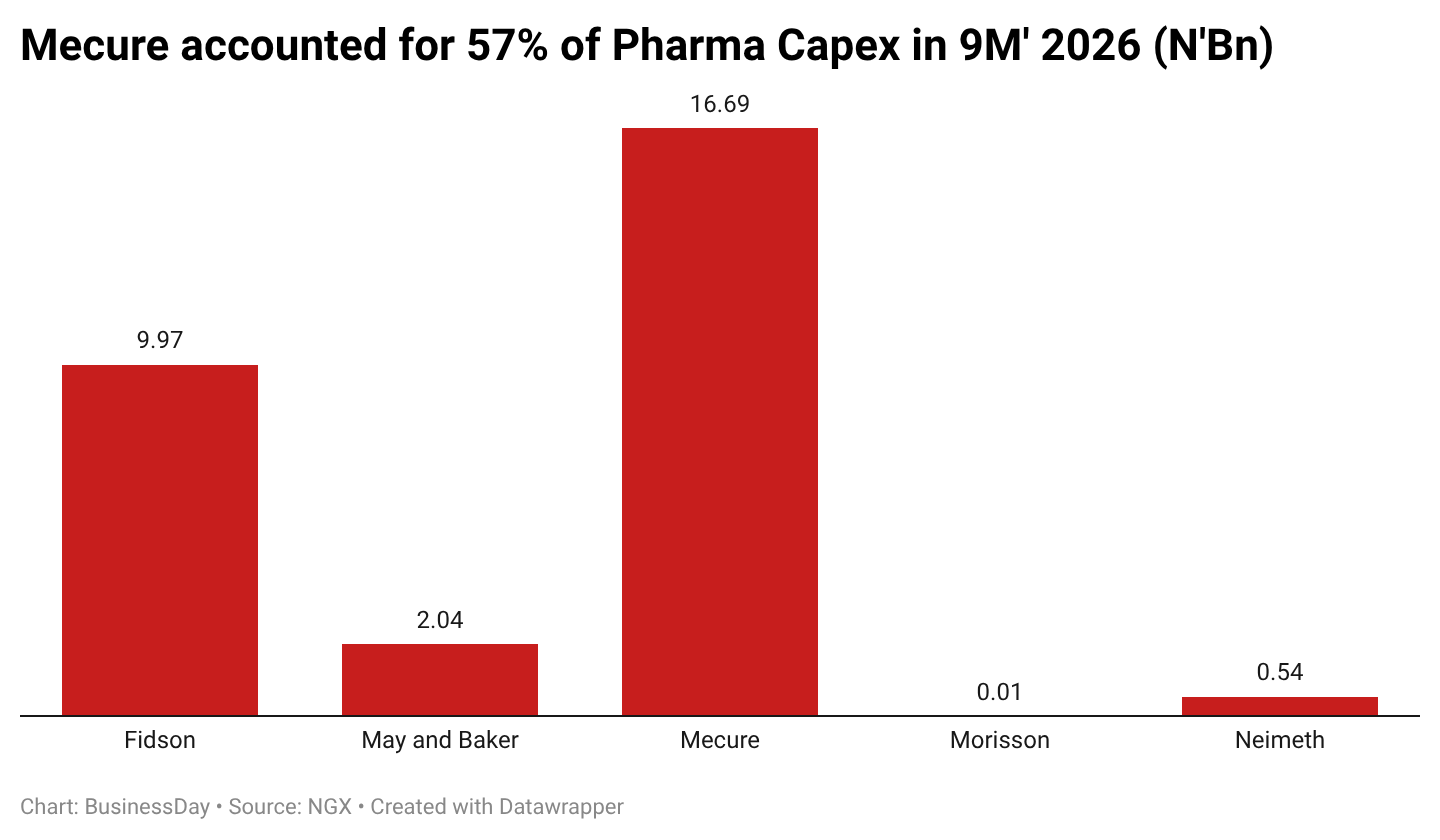
MeCure, however, presents the biggest investment commitment among the five manufacturers. Its N16.69 billion capital expenditure represents approximately 57 percent of the group’s combined spending, making its expansion programme particularly important to the sector’s investment trend.
The company’s property, plant and equipment increased to N53.07 billion in September 2026 from N40.64 billion at the end of 2025, indicating a substantial increase in its asset base.
MeCure is also pursuing additional funding to support its expansion. Shareholders approved an increase in its capital-raising programme from N30 billion to N50 billion in July 2026, with the proceeds intended to support expansion projects and strengthen its financial position.
Its financing activities, however, require attention. MeCure recorded N4.17 billion in net financing inflows during the nine months, compared with N17.54 billion in 9M 2025. Its cash-flow statement showed N14.99 billion in term-loan proceeds and N11.86 billion in commercial-paper repayments.
May & Baker is pursuing a broader investment strategy that combines pharmaceutical production with product diversification and distribution.
In its 2025 annual report, the company identified investments in additional manufacturing machinery, a herbal production plant, water-treatment and bottling lines for its beverage business, and a new sales depot in Abuja.
Management has also identified backward integration along its supply chain as a strategy for reducing production costs. Its increased capital expenditure in 2026 suggests that the company is continuing to commit resources to expanding and diversifying its operations.
Neimeth’s investment programme is more directly centred on rebuilding manufacturing capacity. The company has been developing a new World Health Organization-compliant Good Manufacturing Practice facility in Amawbia, Anambra State, alongside upgrades to its existing Oregun factory in Lagos.
The projects are intended to increase production capacity and improve manufacturing standards. Its funding plans have included a N20 billion capital-raising programme approved by shareholders in 2025, alongside other funding arrangements to support the factory and working-capital requirements.
Despite the acceleration in capital expenditure, the next challenge for the manufacturers is converting their investments into commercially productive assets.
The five companies generated combined operating cash flow of N49.47 billion in the first nine months of 2026, compared with N7.04 billion in the corresponding period of 2025. However, the improvement was uneven, with Fidson and MeCure accounting for much of the increase.
Their combined financing activities also shifted from a net inflow of N13.38 billion in 9M 2025 to an outflow of N14.70 billion in 9M 2026, highlighting the importance of examining how expansion is being funded and whether companies can sustain their investment programmes without putting pressure on their balance sheets.
Ultimately, the increase in pharmaceutical capital expenditure signals a growing commitment to domestic manufacturing, but the commercial success of the investment drive will depend on how quickly new facilities and upgraded production lines become operational.
For investors, the critical measure will not simply be how much manufacturers spend, but whether the additional capacity generates sustainable earnings, stronger cash flows and a more competitive local pharmaceutical industry.
Related News


Source: