“Send It to Me, I’ll Gather It”
Behind every Nigerian wedding, burial and hospital bill is one person matching bank alerts to names long after everyone else has gone to bed. Sparkle’s One Link was built for them.
It is 11.40pm, three days before the burial, and the first son is still awake.
His phone has buzzed all evening. A credit alert, then another, then a voice note from an uncle in Enugu asking whether his own has “entered”. In the family WhatsApp group, which somebody named “Papa’s Final Journey” within an hour of the news, an aunty wants to know why her name is missing from the latest list. He is sure he added her. He scrolls back through two hundred messages to check.
On the bed beside him is an exercise book. Names down the left, amounts down the right.
Some entries are in pen, some in pencil because he was not certain, and a few are just question marks: ₦20,000 from “OKONKWO C.”, in a family with at least four Okonkwos.
If you have ever been this person, you know how the rest of the week goes. If you have not, you have almost certainly sent money to one.
The book that remembers
Outsiders sometimes assume the notebook is about counting. Nigerians understand it as a record of loyalty. It shows who came, who sent something and how much, and families keep it long after the event. When it is your turn to bury a parent or give out a daughter in marriage, somebody will open that book. You stood by us; we will stand by you.
That is why the person keeping it cannot afford a mistake. A missing name reads as a slight, and in some families it starts a quarrel that outlives the occasion.
The same job turns up everywhere. At weddings it falls to the bride’s closest friend, who collects for aso-ebi, gele and the group gift, then spends weeks fielding complaints about colour and delivery. Alumni associations have a treasurer chasing levies for the old school. Every December, someone books the apartment for the group trip and spends January sending polite reminders. Hospital appeals are the hardest: the hospital wants a deposit before treatment can begin, the account number is forwarded to strangers with “this one is real o”, and the organiser keeps posting receipts so people will believe them.
Old habit, new phones
None of this is new. Long before mobile banking, Nigerians pooled money through ajo and esusu in the South-West, isusu in the South-East and adashe in the North. Town unions built roads. Age grades paid school fees. Market women financed one another’s shops.
The money has since modernised. Nigeria’s instant payment system is among the busiest in the world, and a transfer from Houston can land in Owerri before the sender has put the phone down. The record-keeping has not kept up. It moved from the exercise book to the notes app, and in plenty of homes it never left the exercise book.
One link instead of an account number
Sparkle, the digital bank licensed by the Central Bank of Nigeria and founded by Uzoma Dozie, has built One Link, a new feature on SparklePay, for exactly this person.
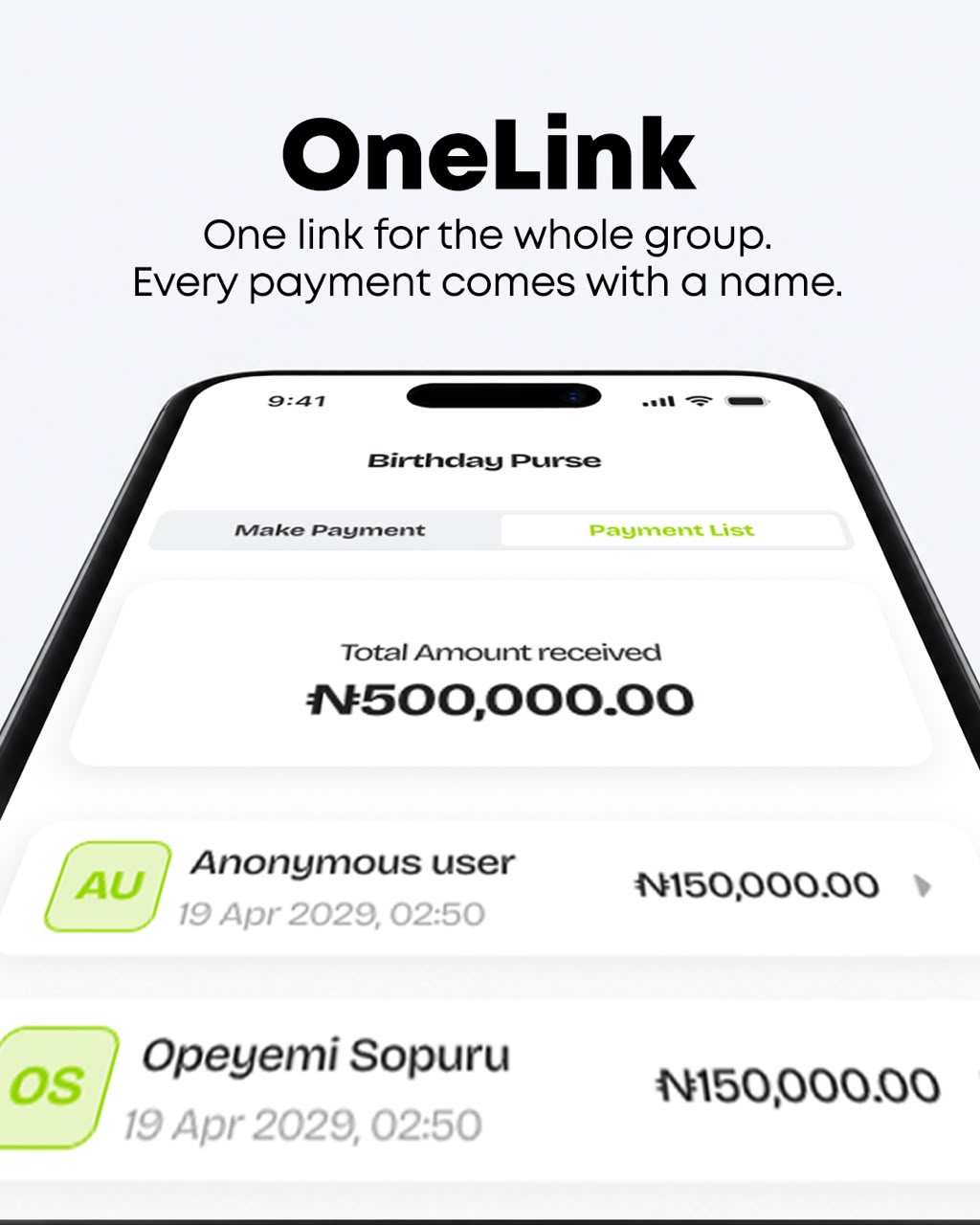
Go back to that burial. This time, instead of an account number, the first son shares a single link in the family group. He names the collection, sets a target and an end date, and chooses whether people give whatever they can or pay a fixed amount, which suits aso-ebi or a group trip. He also decides whether the family can see who has contributed.
The uncle in Enugu does not need to download anything or open a new account. He can pay by transfer from the bank he has used for thirty years, through the Sparkle app, or by scanning a QR code. A family friend who would rather give quietly can do so anonymously.
Every payment lands in one place with the giver’s name attached, so nobody is matching alerts at midnight or guessing which Okonkwo sent ₦20,000. When the aunty asks whether hers arrived, the answer is already on the list. When it is all over, the full record downloads in one go, and the exercise book can stay in the drawer.
Payment links on their own are nothing new.
What One Link adds is the part that has always been done by hand: a single, live list of who has given, which the organiser can share with the group, and which anyone can pay into from any bank without signing up for anything.
Why it matters
It is tempting to call this a convenience. Anyone who has done the job would call it relief.
A shared, accurate record protects the organiser from the quiet suspicion that follows anyone holding other people’s money. It reassures those who gave. And it leaves the family with a clear account of who stood by them when it counted.
For public appeals, visibility matters even more. When strangers can see the target and how close it is, they are more willing to give and to pass the link on, because they can see the appeal is genuine.
For most of our history, clean records like these were something only companies with finance departments could manage. The aunty running the women’s guild collection had a notebook.
The first son had a phone full of screenshots.
One Link puts the same clarity in anyone’s hands, whether the contribution is ₦2,000 from a classmate or ₦500,000 from an old family friend.
“That’s what we do”
Dozie traces the idea to his own childhood. A school friend from England once spent half-term with the family. When it was time for the boy to leave, Dozie’s mother came out and pressed some money into his hand for the road.
“He was like, what is this for?” Dozie recalls. “He was shocked. But it’s in our culture. That’s what we do. Thank you for coming. Thank you for being my son’s friend. Thank you for being part of our family, and go well, travel well.”
Every Nigerian knows that moment: the aunty who presses money into your palm at the door, the uncle who “dashes” you transport fare you never asked for. The burial account and the wedding gift run on the same instinct.
“Sparkle One Link is an expression of that great Nigerian culture of making it easy for us to come together, to contribute and to give at scale,” Dozie says. “One of the challenges is that you want to give, but the process of giving is difficult.”
For him, the point goes beyond convenience. “We need to build solutions around the way that we live, the way we give, the way we contribute,” he says. “That’s one way we actually preserve our culture, enhance it and, to a great extent, export it to other parts of the world.”
Generous, differently
That schoolboy came from a country with a long tradition of charity, of fundraising dinners and collection tins. What surprised him was giving that skipped the institution altogether. Here it is personal and unprompted. We spray money at weddings, send something when a colleague has a baby, and contribute to burials in villages we have never visited, because the family is family.
The numbers back this up. Nigeria ranked fifth in the world in the Charities Aid Foundation’s World Giving Index 2024, and the World Happiness Report 2025 placed it 7th for helping strangers but 45th for donating to charity. We are not short of generosity. We just prefer to give hand to hand.
Afrobeats already fills stadiums in London and New York, and Nollywood plays in living rooms across continents. Dozie hopes the way we show up for one another can travel too, and that a product built in Lagos around Nigerian habits might one day feel just as natural to someone who has never set foot here.
Same generosity, less chasing
The weddings will continue. So will the burials, the naming ceremonies, the class reunions and the December trips. Nigerians will keep giving together.
What can change is the night before. The next time someone in the family group types, “Send it to me, I’ll gather it,” they might actually get some sleep, and enjoy the occasion when it comes.
One Link is available now on SparklePay. For more information, visit sparkle.ng.
Related News


Source: