*… as Farmers Abandon Farms in 2026
By Cynthia Alo
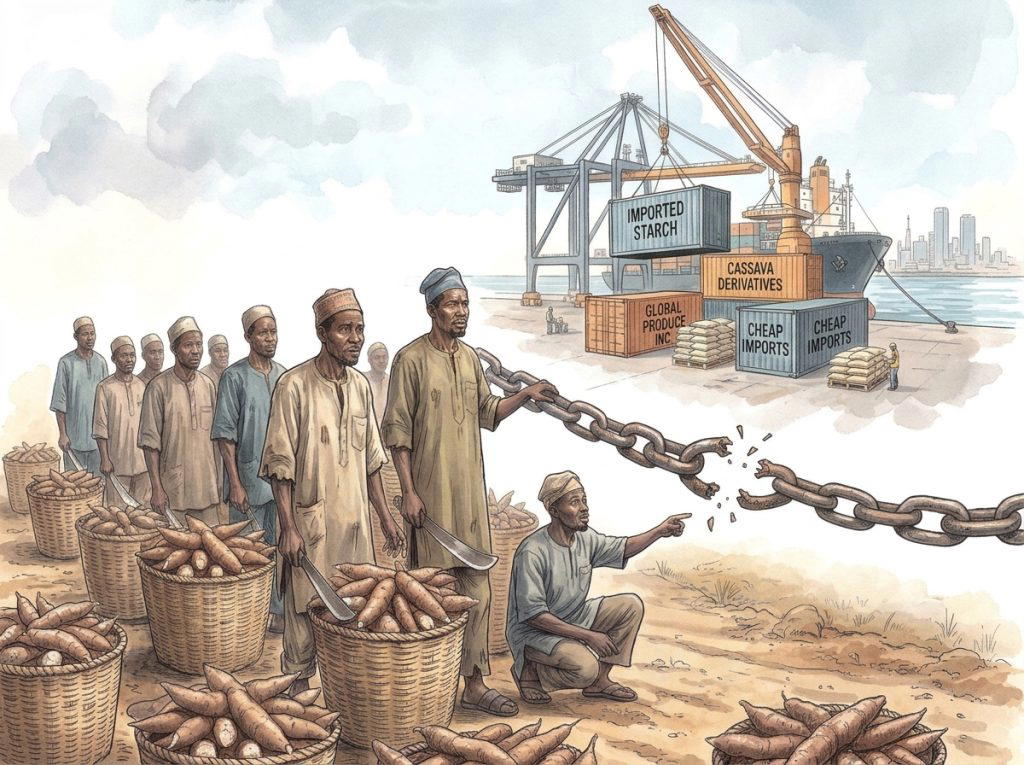
Nigeria’s cassava processing industry is facing a deepening crisis as imports of cassava starch surged by 13,293 per cent in five years, leaving local factories struggling, farmers counting their losses and processors operating at low 15 per cent of their installed capacity.
This is happening despite Nigeria’s position as the world’s largest cassava producer as of 2024, according to the Food and Agriculture Organization Corporate Statistical Database, FAOSTAT, an agency of the United Nations.
Industry stakeholders attributed the crisis to high production costs, inadequate financing, declining farm acreage and weak enforcement of import restrictions. These factors have made imported alternatives cheaper than locally produced cassava derivatives.
The situation has resulted in a glut of raw cassava, falling farm-gate prices, mounting debts among farmers and processors, and growing concerns about the future of local industrial production.
Data obtained from the World Bank’s World Integrated Trade Solution, WITS, based on UN Comtrade records, showed that Nigeria’s cassava starch imports rose from 24.1 tonnes in 2020 to 3,227.7 tonnes in 2025, representing a 13,293 per cent increase over five years.
A year-on-year breakdown showed that Nigeria imported 24.1 tonnes of cassava starch, valued at $69,440, in 2020.
Imports increased by 126.6 per cent year-on-year (YoY) in 2021 to 54.6 tonnes, worth $154,750. In 2022, the volume surged by a further 272.2 per cent YoY to 203.2 tonnes, valued at $292,900.
However, following a sharp rise in the exchange rate, imports plunged by 98 per cent YoY in 2023 to 4.1 tonnes, valued at $32,080, before rebounding sharply in 2024 by 73,004.9 per cent to 2,997.3 tonnes, worth $2.34 million.
The upward trend continued in 2025, with import volumes rising by 7.7 per cent to 3,227.7 tonnes. However, despite the increase in volume, the value of imports declined by 7.6 per cent to $2.16 million from approximately $2.34 million in 2024.
Industry stakeholders, who spoke in exclusive interviews with Financial Vanguard, warned that imports were rising further in 2026 and could continue to increase in subsequent years unless the government addressed the cost disadvantages confronting local processors and strengthened policies supporting domestic production.
Farmers, processors count losses
The President of Large-Scale Starch and Derivatives Producers Association of Nigeria, LSSDPA, Mrs Oluyemisi Iranloye, who is also the Vice-President of the Industrial Cassava Stakeholders Association of Nigeria, ICSAN, said the crisis had severely affected farmers and processors.
Iranloye, founder and Chief Executive Officer of Psaltry International, said farmers could spend about N800,000 cultivating a hectare of cassava but realise only about N300,000 from selling the produce at prevailing farm-gate prices.
She said the situation had discouraged farmers from planting, while industrial processors, which ordinarily absorb substantial quantities of cassava, were scaling down operations because of weak demand.
Illustrating crisis severity in the processing industry, she said: “As you speak right now, factories that should be generating about N10 billion a year are barely generating N1 billion. Factories are running at about 15 per cent capacity because there’s no market.
“The market that is available is flooded by importation. So factories are dying, people cannot pay up their loans. We buy from smallholder farmers, and when we are not buying, smallholder farmers cannot sell, and the implication is that everybody suffers.
“What we have witnessed over the last 18 to 20 months is particularly troubling. Several processing companies have either reduced their operations, struggled to maintain production or become less active in the market.
“Consequently, the volume of cassava that would ordinarily have been absorbed by industrial processors has increasingly remained within the traditional food market, putting considerable pressure on farm-gate prices.”
Iranloye warned that the situation could also threaten future cassava supplies as farmers become increasingly reluctant to invest in cultivation when they cannot recover their production costs.
She said the solution laid in addressing the broader production and supply-chain constraints.
“We must also invest in the agricultural supply base, mechanisation, improved planting materials, aggregation centres, transportation and alternative energy solutions,” she said.
Tariff favours imports
Explaining the factors behind the growing dependence on imported starch, Iranloye said the current tariff structure had made imported corn starch and pharmaceutical-grade starch cheaper than locally produced cassava starch.
According to her, the reduction in tariffs on competing products, such as corn starch and pharmaceutical-grade starch, had made imported alternatives more competitive than locally produced cassava starch
She said: “I believe this report, the imports will increase in 2026 because the import duty is still supporting cassava starch and corn starch, a situation that large-scale starch and its derivative producers have been fighting.
“Now, the situation is that the tariff on corn starch used to be about 15 per cent some four years ago, and at that point, we were able to compete because we had some form of little protection.
“But right now, the tariff on corn starch and pharmaceutical-grade starch were reduced to five per cent. What it means is that they can bring it in cheaper than what we are producing.
“So, the multinationals that usually buy from us, the large-scale starch factories in Nigeria, are now importing, landing cheaper than our cost of production, so they now import thousands of containers, and they now buy very little locally.
“The implication is that we are also not buying much cassava from farmers, so prices have crashed below what the farmers can handle, and that’s why we have the glut right now.”
Iranloye said pharmaceutical-grade starch was also being brought into Nigeria under zero-duty arrangements, with some importers allegedly importing quantities beyond their immediate requirements and selling the excess in the local market.
She said: “Another point is pharmaceutical-grade starch also finds its way into Nigeria. So pharmaceutical companies are importing pharmaceutical-grade starch into Nigeria at zero duty.
“But instead of just importing the quantity that they require alone, they import more and sell also to the local market.
“So we have been fighting the importation heavily, yet we have more than 30 factories not running well, cassava not being bought, there’s glut because of tariff mismatch.”
The Federal Government’s Executive Order on Increasing Local Production of Healthcare Products provides import-duty and VAT exemptions for specified pharmaceutical raw materials.
The official list of exempted materials specifically includes pharmaceutical-grade corn starch under HS Code 1108121000.
Farmers warn of further supply decline
Meanwhile, food security expert and farmer, Mr Africanfarmer Mogaji, said Nigeria could continue to experience increased importation in 2026, particularly through less-publicised channels, if government policies remained inconsistent.
Mogaji said Nigeria had significantly expanded its cassava processing capacity over the past decade, particularly as foreign exchange pressures made imports more expensive and encouraged manufacturers to source raw materials locally.
However, he said many farmers and processors who invested during that period are now heavily indebted following changes in market conditions.
He said: “The processors have increased capacity by taking loans because of the demand previously. The farmers have taken loans, taken too much risk, over-exposed themselves.
“And now it is cheaper to import cassava starch from Thailand because the government of that country has heavily invested in infrastructure from raw material to inputs to logistics.
“So many of the multinationals have over-imported and they are not taking the starch from the Nigerian processors, and so the processors also cannot take cassava from the local farmers.”
Mogaji said some multinational companies had taken advantage of import windows to bring in quantities beyond their immediate requirements, thereby weakening demand for locally produced cassava derivatives.
He said the impact could persist beyond 2026 because some manufacturers had already secured imported supplies for an extended period.
He said: “They’ve secured themselves mostly till the end of 2027 and first quarter 2028.
“So Nigerians will feel it on their table again. And so whatever government is trying to do to tighten up to support local production will be a waste.”
Mogaji said Nigeria needs a long-term agricultural policy framework that will enable farmers and processors to plan beyond individual administrations.
He said: “If we don’t have policies that can last an average of 10 years in the pilot stage, we’re not going anywhere.
“But we can convert and focus on food, maybe cassava to fufu, cassava to garri, cassava to paste, cassava to many other products that people can consume at scale.
“I’m optimistic there’s still room for the private sector, but over-dependence on government would not work.”
Farmers reduce acreage as costs rise
Similarly, the Managing Director of Niji Group, Mr Kolawole Adeniji, said the projected increase in imports in 2026 will also be driven by a decline in cassava farming activities this year.
Adeniji, who has more than 36 years of experience in agriculture and operates a cassava farm covering more than 4,000 acres, said farmers were reducing farm sizes because of the high costs of machinery, diesel and transportation, insecurity, and poor returns on cassava cultivation.
He said: “The import will increase next year because a lot of people are not farming this year. Farmers have reduced the acreage of their farm sizes due to the implements and the cost of tractors, insecurity, then the poor market for what they have planted over a period of three years.
“So a lot of people are not doing any serious farming this year. The cost of diesel is very high, so the cost of transportation is very high. The cost of selling tractors, when you look at all the factors surrounding the production, people are not farming the way they should. So it’s going to affect us next year.”
Adeniji also attributed Nigeria’s dependence on imported starch to the high cost of producing and processing cassava locally, saying farmers and processors faced expenses that producers in competing countries do not bear to the same extent.
He said: “Most of the farmers who are practising are not making profit because the supporting system is not properly structured.”
According to him, imported starch, including potato and maize starch, can also be cheaper than locally produced cassava starch because of differences in infrastructure, energy and production costs.
He said: “Immediately the government opened the border to bring starch, the cost of producing potato starch and everything is cheaper than what you produce in Nigeria.”
Adeniji also said cassava processing required long-term financing, arguing that farmers and processors could not operate sustainably with short-term loans.
He said: “If the government wants to provide loans, it must be almost a three year cycle.”
Processing capacity struggles despite investment
Despite the challenges, industry records showed that Nigeria has developed significant cassava processing capacity over the years.
A June 18, 2026, document obtained by Vanguard from the Large-Scale Starch and Derivatives Producers Association listed 62 cassava processor entries affiliated with the association, including processors registered with ICSAN.
The records showed that 55 entries were engaged in starch and high-quality cassava flour, HQCF, processing, with a combined listed daily capacity of 1,662.5 tonnes, while seven ethanol-related processors had a combined recorded capacity of 1.073 million litres daily.
Among the companies listed for starch and HQCF production were Psaltry International Limited, Dufil Prima Foods Limited, GreenTech Industries Limited, Harvest Feed and Agro Processing Limited, Niji Industries Limited, Acsmin Cassava Industries and Premium Cassava Product Limited.
The ethanol processors included Green Hills Agricultural Products, Premier Plantations Limited, Weewood Industries Limited, Allied Atlantic Distilleries Limited, Pure Biotech Company Limited, Unicane Industries Limited and Arog BioAllied Agro Services Limited.
However, the association noted that some companies might not be operating at full capacity because of challenges, while some companies, including those operated by Chinese investors, were not captured in the list.
Production versus industrial use
The concerns come despite Nigeria’s position as the world’s largest cassava producer.
Data from the Food and Agriculture Organization Corporate Statistical Database, FAOSTAT, released in 2025, showed that Nigeria accounted for about 18 per cent of global cassava output in 2024, ahead of the Democratic Republic of Congo and Ghana, while national production had risen to more than 63 million tonnes.
However, the country’s large production volume has not translated into commensurate industrial utilisation.
Speaking at the 10th anniversary of ICSAN in Lagos, its President, Mr Segun Ladele, said only about five per cent of Nigeria’s cassava output currently goes into industrial use, with the bulk consumed as food or exported.
He said: “About 80 per cent is consumed locally as food, five per cent goes into industry and about 15 per cent for export. So when we are talking about industrialisation, there is still a lot of room to make improvements.”
The post Crisis hits Nigeria’s cassava industry with imports rising 13,293% in 5yrs appeared first on Vanguard News.
Source: