Data has officially emerged as king on the balance sheets of Africa’s largest telecommunications operators. Across the H1 2026 financial results of MTN Nigeria, Airtel Africa, and Safaricom, one structural theme dominates: data is surging to become the primary engine of revenue, while legacy voice continues to thin out as a growth lever.
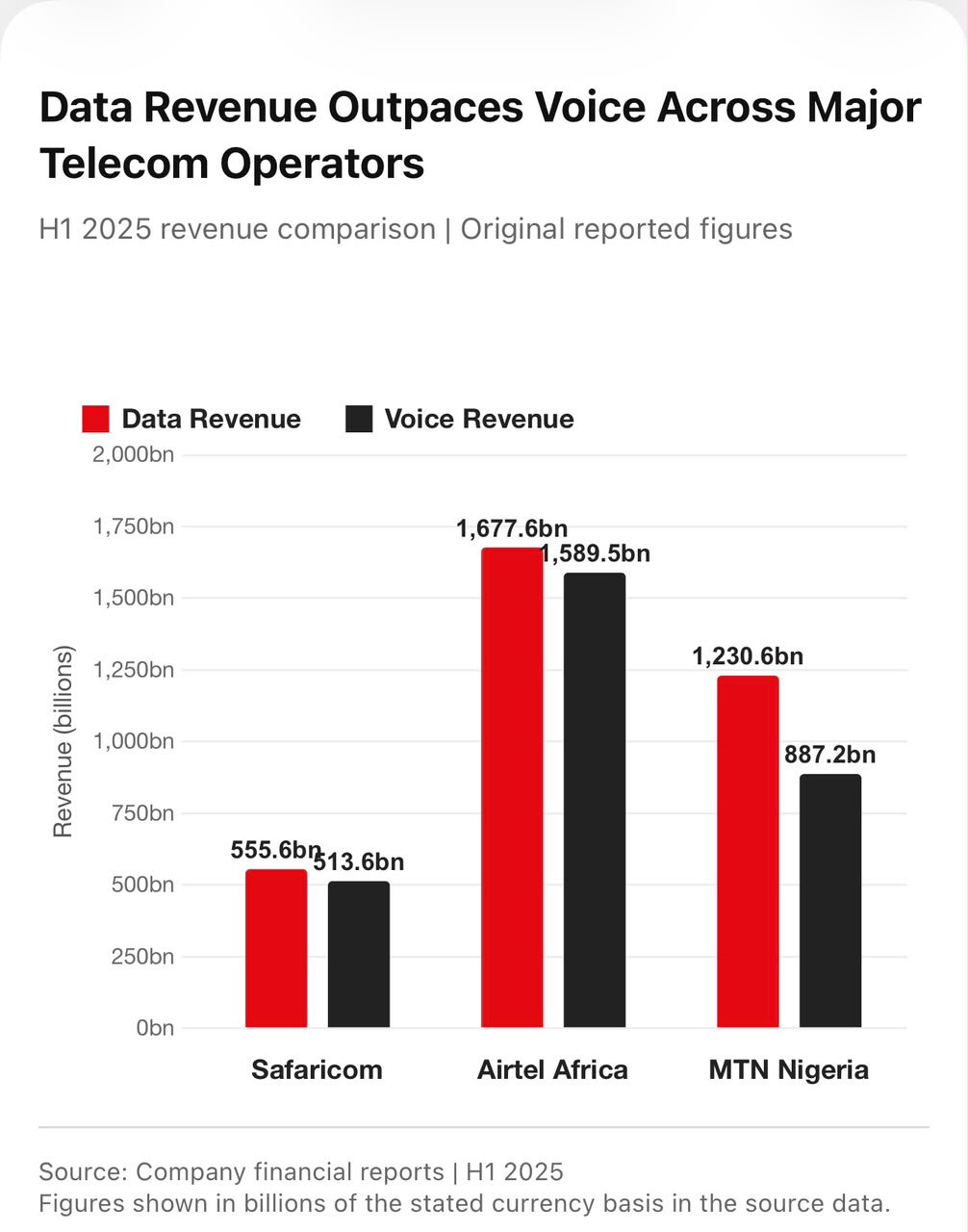
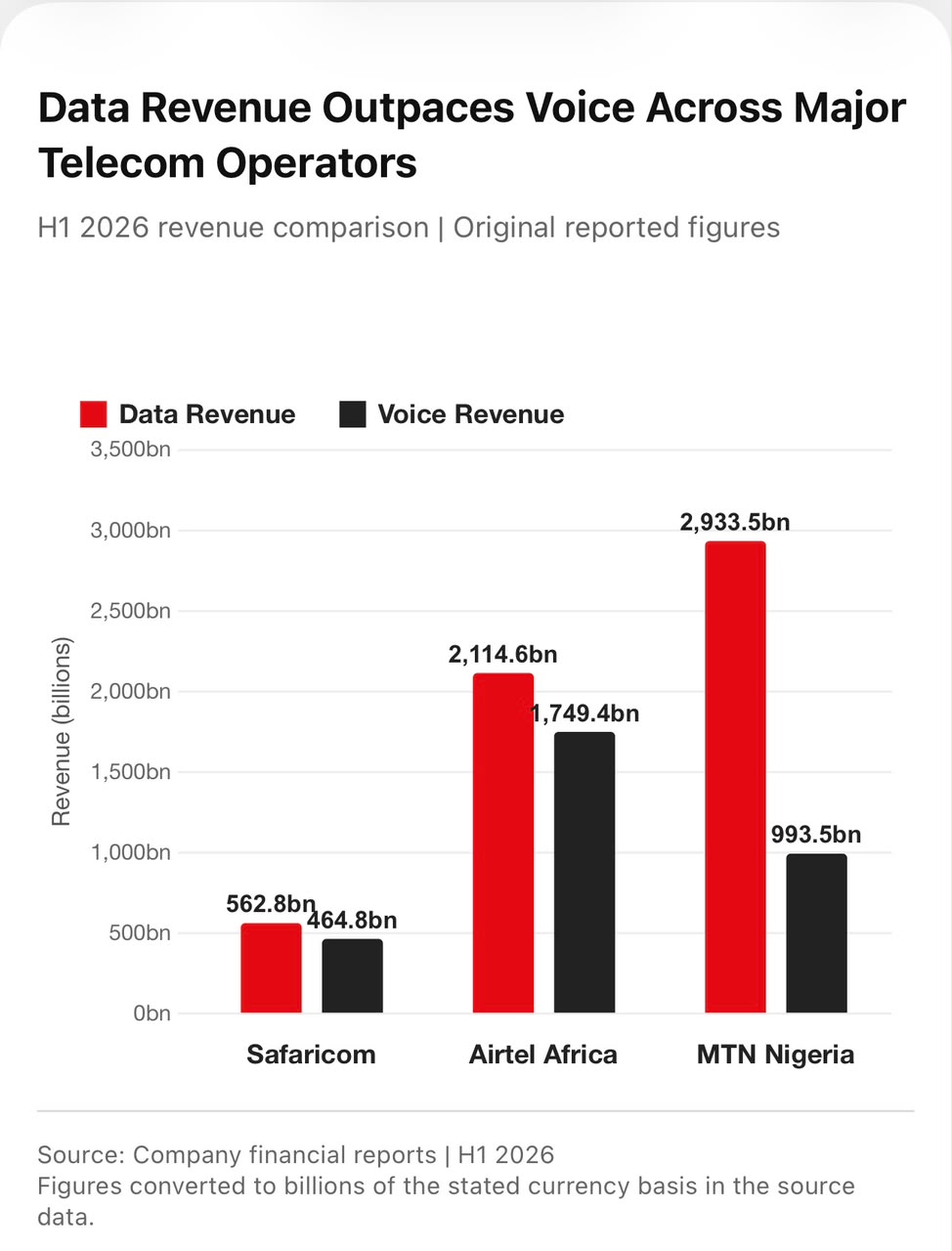
In the first half of 2026, the three telecom giants recorded a cumulative N5.6 trillion in data revenue, a 61.8 percent jump from the N3.46 trillion posted in H1 2025 (All revenue has been converted to naira). Over the same period, cumulative voice revenue crept up by just 10.3 percent, rising from N2.9 trillion to N3.2 trillion. Expanding at more than six times the pace of voice, data has cemented its status as the core business, leaving voice as a defensive, mature revenue line.
H1 revenue comparison in naira (Combined Operators)
| Revenue Segment | H1 2025 | H1 2026 | YoY Growth |
| Data Revenue | N3.46 Trillion | N5.60 Trillion | +61.8 percent |
| Voice Revenue | N2.90 Trillion | N3.20 Trillion | +10.3 percent |
From early momentum to an irreversible shift
While the pivot toward data began reflecting on balance sheets around 2024, early growth was uneven—frequently disrupted by macroeconomic shocks, inflation, and currency devaluations. By 2026, however, the shift became unmistakable.
At the end of 2019, mobile internet adoption stood at just 26 percent across sub-Saharan Africa, leaving nearly 800 million people unconnected (with Kenya sitting marginally higher at 27 percent). Today, driven by 4G expansion and rising device accessibility, smartphone adoption has reached 64 percent across sub-Saharan Africa and 55 percent in East Africa. Even though device affordability remains a barrier for entry-level consumers, digital-first habits have permanently taken root.
How the giants compare: Safaricom, MTN, and Airtel
Safaricom (East Africa)
For Safaricom, mobile data has become the centerpiece of its growth strategy. In its H1 2026 results, data contributed 46 percent ( N562 billion or KES 53 billion) of total connectivity revenue, up from 43 percent (N555 billion or KES 44 billion) in H1 2025. This momentum was powered by an 11.6% year-on-year rise in one-month active chargeable data customers to 27.86 million, alongside targeted affordability initiatives like Tunukiwa Plus. Notably, heavy users consuming more than 1GB per month jumped 17.7% to 15.21 million.
“Our objective is not simply to provide more data. We want connectivity to become increasingly useful in how customers work, learn, transact, access entertainment, and manage their daily lives,” said Peter Ndegwa, Safaricom Group CEO. “This requires propositions that reflect different customer needs, usage patterns, and affordability levels. Voice remained resilient and continues to play an important role in keeping customers connected.”
MTN Nigeria
In West Africa, MTN Nigeria’s H1 2026 report placed data firmly in pole position. Data revenue climbed 38.4 percent to N1.70 trillion, up from N1.23 trillion in H1 2025—comfortably outpacing voice revenue, which moved from N887 billion in H1 2025 to N993 billion in H1 2026.
“Network data traffic rose by 25.8 percent, while average usage per subscriber increased by 15.2 percent to 14.8GB, reinforcing the depth of demand and the importance of continued capacity investment. With smartphone penetration at 66.4 percent, data remains our largest structural growth opportunity,” MTN noted in its financial filings.
Airtel Africa
Airtel Africa mirrored this trajectory across its footprint. In H1 2026, data revenue surged 28 percent to $1.57 billion (N2.11 trillion) up from $1.16 billion (N1.67 trillion) in H1 2025, pulling further ahead of voice revenue, which rose from $1.10 billion (N1.58 trillion) to $1.29 billion (N1.74 trillion) over the same period.
Capital reallocation and the sunset of 3G
As data consumption accelerates, operators are aggressively redirecting capital expenditures away from legacy 2G/3G voice infrastructure toward 4G densification and targeted 5G rollouts.
Before 3G, internet access in Nigeria was largely confined to cybercafés; after 3G, it lived in people’s pockets. Today, however, 3G sits in an uncomfortable middle ground—too slow for modern streaming and increasingly inefficient to maintain commercially. Following over N2 trillion in industry-wide network infrastructure investments across Nigeria in 2025, expansion continued into 2026. MTN Nigeria’s 4G population coverage has surpassed 84.6 percent, while Airtel Nigeria serves over 31 million active data subscribers. Meanwhile, 5G—launched commercially in August 2022—reached 4.34 percent penetration by April 2026 according to NCC data, highlighting rapid migration away from 3G.
Between 2025 and 2026, MTN Nigeria doubled its CapEx to N1 trillion, while Airtel Africa deployed $884 million to roll out over 3,250 new sites. Rather than chasing costly nationwide 5G coverage, telcos are prioritising 4G capacity and fibre backhaul while concentrating 5G strictly in high-density urban hubs like Lagos, Abuja, Port Harcourt, and Kano.
Pairing Data with Fintech
Because high-volume data networks require relentless capital spending to maintain service quality, telcos have shifted their commercial focus from pure SIM additions to maximising Average Revenue Per User (ARPU) through bundled digital experiences and mobile money.
Airtel Africa’s half-year performance underscores this synergy: mobile money revenue grew 34.8 percent in reported currency (and 25.8 percent in constant currency), propelled by a 22.4 percent jump in its customer base to 60.9 million and a 2.6 percent rise in ARPU to $2.50. Across the continent, pairing ubiquitous data connectivity with high-margin fintech ecosystems—Safaricom’s M-Pesa, MTN’s MoMo, and Airtel Money/SmartCash—has become essential to defending operating margins.
The H1 2026 financial results from MTN Nigeria, Airtel Africa, and Safaricom mark an operational point of no return.
Heading into 2027, the central challenge for African telcos is no longer convincing consumers to adopt mobile data: the market has already crowned data as king. Instead, success will depend on how effectively operators manage foreign exchange exposure on imported network hardware, expand fibre backhaul to prevent congestion, and scale fintech ecosystems as traditional voice revenue slowly fades into the background.
______________________________________________________________________________________________________________________________________
Using 1KES to N10.60 in 2026
Using 1KES to N12.50 in 2025
Using $1 to N1346 in 2026
Using $1 to N1445 in 2025
Related News


Source: