International trade plays a significant role in the economies of some countries, with imports and exports accounting for several times the value of their annual economic output. While major economies such as the United States and China dominate global trade in absolute value, smaller countries often depend more heavily on international markets relative to the size of their economies.
The World Bank’s trade-to-GDP indicator offers a way to measure this relationship. It compares the combined value of a country’s exports and imports of goods and services with its gross domestic product (GDP). The resulting percentage provides an indication of how exposed an economy is to international trade.
According to the latest available World Bank figures, Luxembourg, San Marino and Singapore are among the countries with the highest trade-to-GDP ratios globally. Here are the 10 most trade-dependent sovereign countries based on the latest available data.
Luxembourg – 349.9%
Luxembourg ranks first, with international trade equivalent to approximately 349.9 per cent of its GDP in 2025. This means the combined value of its exports and imports was about three and a half times the size of its annual economic output. The country’s position reflects its small, highly open economy and its extensive international business relationships. Financial services play a particularly important role in its cross-border economic activity, alongside trade in goods and other services. In 2024, Luxembourg recorded €334.8 billion in combined trade in goods and services, equivalent to approximately 390 per cent of GDP under the French Treasury’s reported methodology. Services accounted for much of this activity, generating a substantial trade surplus. Its membership of the European Union and access to the European single market also support extensive cross-border business activity.
San Marino – 341%
San Marino recorded a trade-to-GDP ratio of approximately 341 per cent, using its latest available data from 2023. Surrounded by Italy, the small European republic has a domestic market that makes international economic relationships particularly important. Its geographical position and close economic links with its neighbour influence the movement of goods, services and business activity across its borders. Its high ratio illustrates how a relatively small economy can record international trade flows several times larger than its domestic economic output.
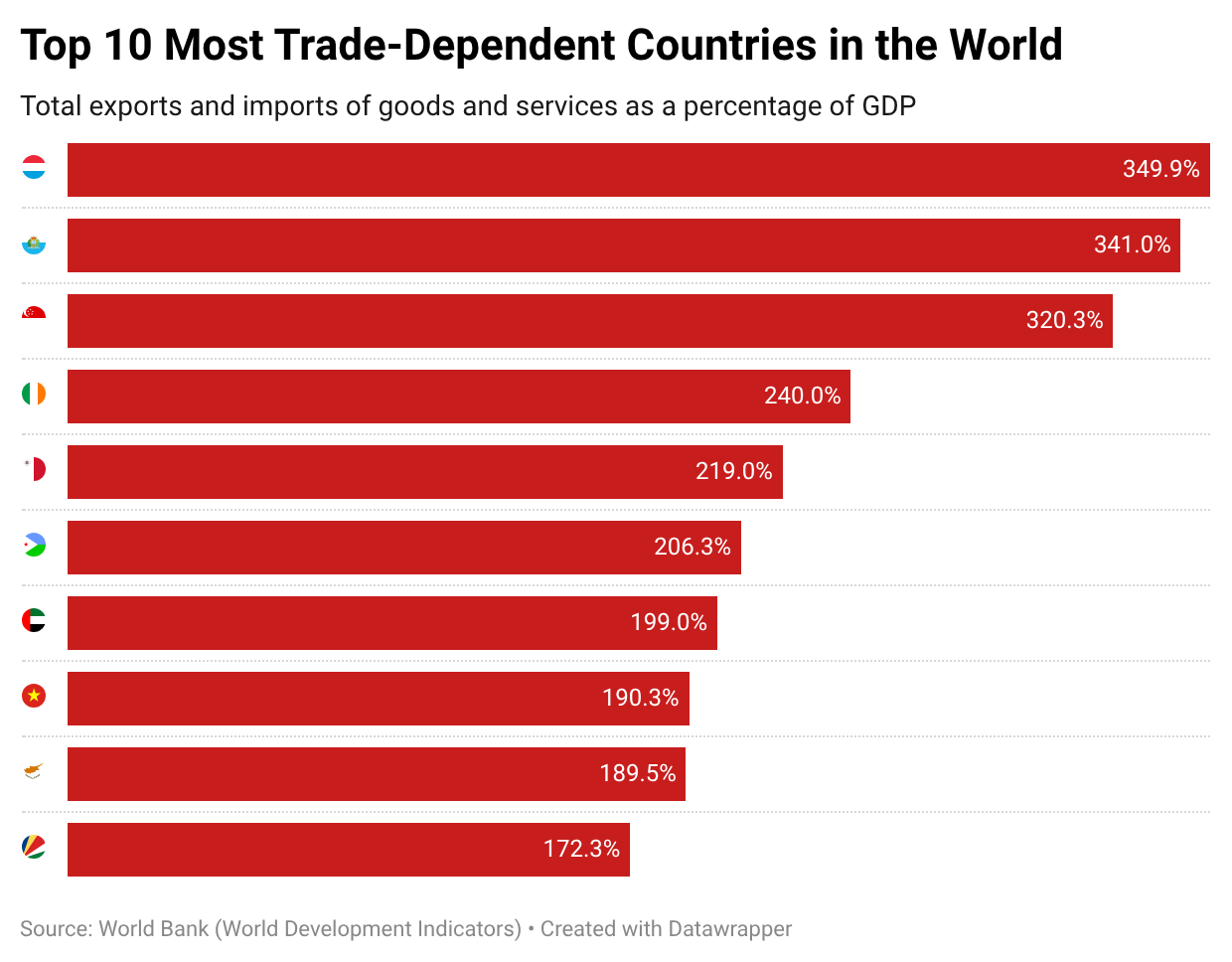
Singapore – 320.3%
Singapore’s trade-to-GDP ratio stood at approximately 320.3 per cent in 2025, placing it among the world’s most internationally connected economies. The country has developed into a major global trading and logistics centre, supported by its strategic location along important international shipping routes. Its port, financial services industry and role in international supply chains contribute to its extensive trade activity. UN Trade and Development (UNCTAD) reported merchandise exports of approximately $505.7 billion and imports of $458.7 billion in 2024. Its trade activity also extends beyond physical goods to include financial, transport and other business services.
Read also: Nigeria’s economy set to sustain growth as Q3 forecast points to 4.4%
Ireland – 240%
Ireland recorded a trade-to-GDP ratio of approximately 240 per cent in 2025. Its economy has strong international connections, particularly in pharmaceuticals, chemicals, medical products and technology-related industries. Foreign multinational companies have established significant operations in the country, making international production and distribution important components of its economic activity. According to Ireland’s Central Statistics Office, the country exported €223.7 billion worth of goods and imported €134.7 billion in 2024. Chemicals and related products accounted for almost two-thirds of its merchandise exports, valued at €145.3 billion. The United States was its largest individual trading partner, receiving €73.5 billion in Irish goods exports that year.
Malta – 219%
Malta’s trade-to-GDP ratio reached approximately 219 percent in 2025, reflecting its reliance on international markets for both goods and services. The Mediterranean island has a relatively small domestic market and an economy with significant international business, transport and tourism activities. UNCTAD’s 2024 country profile recorded merchandise exports of approximately $3.8 billion and imports of $9.5 billion. However, services contributed substantially to its international trade, with exports valued at approximately $24.7 billion and imports at $17.2 billion. Transport, travel and other business services featured prominently in its services exports.
Djibouti – 206.3%
Djibouti recorded a trade-to-GDP ratio of approximately 206.3 percent in 2025. Its location at the southern entrance to the Red Sea gives it strategic importance in international shipping and regional commerce. The country serves as a logistics and trade gateway, particularly for neighbouring landlocked Ethiopia, which relies on the Djibouti-Ethiopia corridor for access to international markets.Port operations, logistics and transport services are therefore important to its economic structure. However, trade dependence also reflects domestic supply limitations. The World Bank notes that Djibouti has limited arable land and relies heavily on imported food.
United Arab Emirates – 199%
The United Arab Emirates recorded a trade-to-GDP ratio of approximately 199 per cent in its latest available observation, from 2023. The country’s position is supported by its role as an international business, logistics and trading centre. Its ports, airports and commercial infrastructure facilitate the movement of goods between Asia, Europe, Africa and other markets. Dubai, in particular, has developed into a major centre for re-export trade, where goods imported into the country are subsequently shipped to other destinations. Although petroleum remains important to the UAE economy, its international commercial activities extend to transport, financial services, tourism and other sectors.
Vietnam – 190.3%
Vietnam recorded a trade-to-GDP ratio of approximately 190.3 percent in 2025, highlighting the importance of international commerce to its rapidly developing economy. The country has become an important manufacturing and export base, producing goods for international markets across sectors such as electronics, textiles, footwear and machinery. Its integration into global supply chains has attracted foreign investment and expanded its role in international manufacturing. World Bank trade statistics show the scale of this activity. Vietnam recorded merchandise exports of approximately $353.1 billion and imports of $325.4 billion in the latest figures presented in its trade profile. Its reliance on imported production inputs and overseas demand means that changes in international trade conditions can have significant implications for its manufacturing sector.
Read also: Opposition parties navigate internal rifts, third-force prospects ahead of 2027 polls
Cyprus – 189.5%
Cyprus recorded a trade-to-GDP ratio of approximately 189.5 percent in 2025. The island economy has strong international connections through services, particularly financial services, transport, tourism and business activities. According to UNCTAD’s 2024 country profile, Cyprus exported approximately $31.1 billion in services and imported $22 billion. Telecommunications, computer and information services, financial services, transport and travel contributed to these figures. Tourism is another important part of its international economic relationships. The country’s Statistical Service recorded approximately 4.04 million tourist arrivals in 2024, representing an increase of 5.1 per cent from the previous year.
Seychelles – 172.3%
Seychelles completes the ranking, with a trade-to-GDP ratio of approximately 172.3 percent in 2025. The Indian Ocean island nation has a relatively small domestic market and depends on international commerce for essential supplies, alongside revenue generated by its export-oriented industries. Tourism and fisheries are central to its economy. Its exports include fish and processed seafood, while imports cover food, fuel, machinery, manufactured goods and other essential products. The World Bank identifies tourism and fisheries as two of the country’s principal economic sectors. This structure makes international visitor demand, overseas seafood markets and the cost of imported goods particularly important to its economic outlook.
Related News

Esther Emoekpere is a data analyst in the audience engagement department at BusinessDay, where she uses data to understand reader behaviour, spot unusual trends, and support the newsroom with insights that shape story performance. She holds a BSc in Statistics from the Federal University of Agriculture, Abeokuta.
She also with the BD Weekender team, where she covers a range of beats including profiles, food, lifestyle, restaurants, and fashion—creating stories shaped by audience interest and real-time engagement trends.


Source: