The first published report by Midlo Research Institute has ranked the 20 largest verifiable startup collapses in Kenya, Nigeria and Ghana, finding that the companies raised about $923 million in total while documented returns to investors came to just $5.0 million, or 0.5%.
The report, titled AFRICA FAILURE INDEX – WHERE THE MONEY WENT was produced by the Midlo Research Institute, the research arm of the Midlothian Angel Network, in partnership with Nairametrics.
It benchmarks Africa’s ten largest collapses against the ten largest venture-backed failures since 2020 in North America, Europe and Asia, and uses 20 case files to trace how a typical collapse unfolds, from the peak of a funding round to administration or wind-down.
No audited loss figure exists, so the report sets a ceiling
None of the 20 companies has an audited investor loss on the public record, and 15 have no disclosed recovery figure. The report therefore sets a ceiling instead: capital lost cannot exceed $917.9 million, and the real figure is lower.
Part of the money was also debt. At least $149.6 million, or 16%, of the $923 million was debt or convertible instruments, which means some of the loss falls on lenders and secured creditors ahead of equity investors.
Africa’s failures are one-tenth the size, not one-tenth as severe
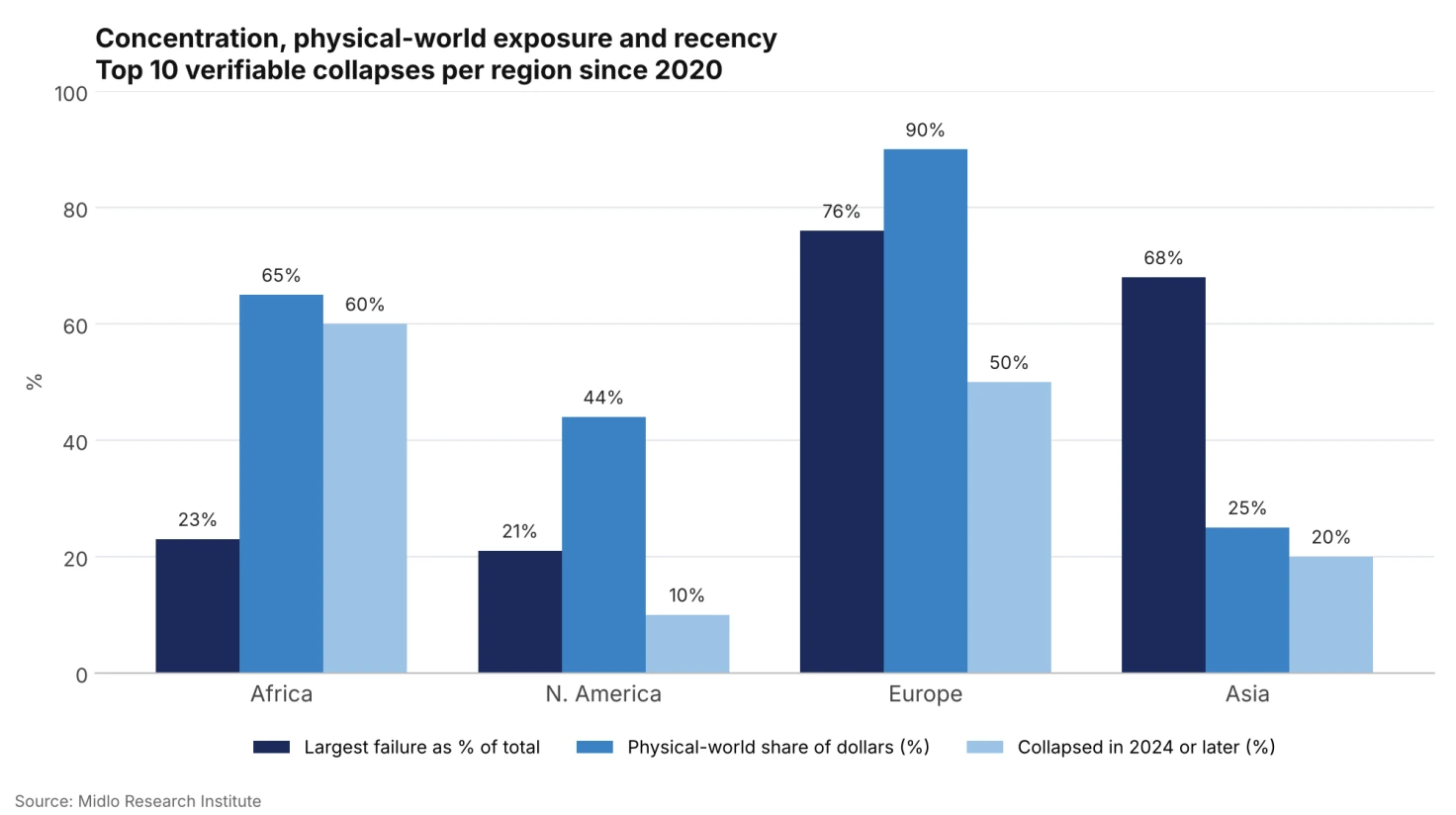
Africa’s ten largest collapses since 2020 raised a combined $812 million, compared with $8.3 billion in North America, $17.1 billion in Europe and $8.8 billion in Asia. Twiga Foods, at $185.4 million, is the largest African case. The largest in the other regions are Quibi at $1.75 billion, Northvolt at more than $13 billion and Byju’s at $6 billion.
The report cautions against taking comfort from the smaller numbers. Measured against a single year of African venture funding, Africa’s top ten failures equal about a fifth of it, close to Asia’s ratio and far above North America’s. Six of Africa’s ten collapsed in 2024 or later.
Trucks, stoves and warehouses account for 59% of the dollars
Seven asset-heavy companies, including Twiga Foods, Copia, Koko Networks and Mobius Motors, account for $548.8 million, or 59% of the total. The report says the best predictor of a very large failure was a business with trucks, stoves, warehouses, fuel points or agents.
- Fintech accounts for nine of the 20 companies but only 19% of the dollars.
- Distribution and supply-chain businesses are six of the 20 companies but 46% of the dollars.
- Physical-world businesses made up 65% of the dollars in Africa’s ten largest collapses, against 44% in North America.
Kenya holds 77% of the dollars; Nigeria’s eight collapses raised $104.7 million
Ten Kenyan companies hold $715.1 million, or 77% of the total. Nigeria’s eight collapses raised $104.7 million combined, and Ghana’s two raised $103.1 million. The largest Nigerian case is 54gene at $45 million.
Currency exposure was visible in at least six cases, including Kippa, Edukoya, Pivo, Float, Lipa Later and Okra, after the 2023 naira devaluation.
The warning signs were public
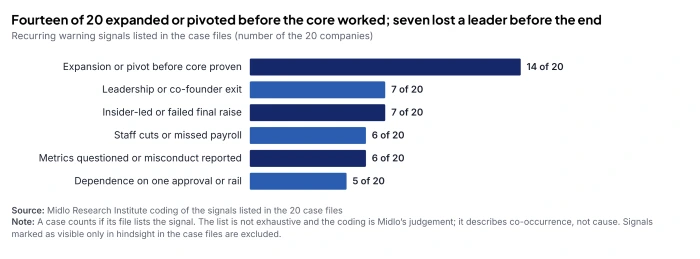
Fourteen of the 20 companies expanded or pivoted before the core business worked. Kippa launched three products in about 13 months, and MarketForce reached five countries in three years. Seven lost a founder or senior leader before the end, and seven had an insider-led or failed final raise.
The report also finds that the 2021 boom financed most of the failures. Of the capital that could be dated, $228.3 million arrived in 2021 alone, more than the 2022 and 2023 figures combined. No funding round in 2025 or 2026 could be identified, even though those were the years in which the largest failures arrived.
A record, not a verdict
The report describes itself as a ranking of verifiable cases rather than a census. It grades the evidence for each case separately from the causes, attributes allegations to the outlets that reported them, and discloses the Institute’s ties to two of the companies examined.
Founder Wale Salami opens the report with the story of a $1,000 investment in Ghanaian fintech Dash that was worth 11.3 times as much within nine months, before the company collapsed. “An honest record of what went wrong is among the most valuable assets an ecosystem can build,” he writes.
The report closes with practical guidance for investors, founders and the wider ecosystem, and an outlook on what to watch next, including debt repayments, currency exposure and open administrations.
What you should know
- The ranking uses public reporting available on 5 October 2026, so the status of individual companies may have changed since.
- African trackers disagree by a factor of 2.5 on 2025 funding: Disrupt Africa recorded $1.64 billion, Bloomwit $3.9 billion and Partech $4.1 billion.
- Partech recorded debt at a record $1.64 billion in 2025, or 41% of African tech funding, up from 17% in 2019.
- Where the Money Went will be released on November 18th.
Disclosure: Midlo Research Institute is the research arm of the Midlothian Angel Network. Payday, one of the companies examined in the report, is a Midlo portfolio company.
Source: