The Federal Government of Nigeria has moved aggressively to lower the barriers to intra-African trade by signing a three-year operational roadmap with RwandAir, unlocking heavily subsidised freight rates for local businesses targeting East and Southern African markets.
The agreement, formally executed between the Federal Ministry of Industry, Trade and Investment and the Rwandan national carrier, was signed on the sidelines of the CANEX WKND 2026 at the Wole Soyinka Centre for Culture and Creative Arts in Lagos.
By leveraging the African Continental Free Trade Area (AfCFTA) framework, the partnership slashes the cost of transporting Nigerian goods to Kigali, Nairobi, Johannesburg, Harare, and Lusaka by up to 75%.
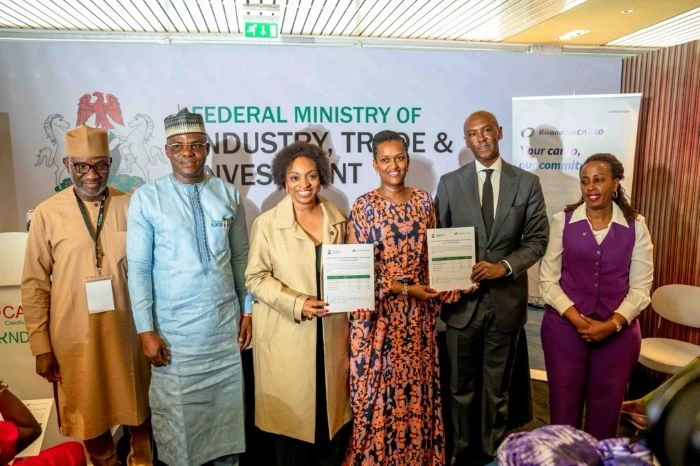
Historically, Nigerian exporters paid commercial carriers between $3 and $10 per kilogram to reach these markets – a prohibitive premium that severely undermined the price competitiveness of Nigerian products and kept non-oil export volumes artificially low.
Cost breakdown and export requirements
With the corridor now officially open following a successful four-month pilot phase, the new pricing structure offers a highly competitive sliding scale based on destination and volume.
Shipments to Kigali are priced at $1.40 per kilogram for consignments below 1,000kg, dropping to an even more competitive $1.20 per kilogram for larger volumes. Rates to Johannesburg range from $1.70 to $1.90 per kilogram, while shipments to Nairobi, Lusaka, and Harare will cost exporters between $1.50 and $1.80 per kilogram.
However, the subsidised freight rates do not cover the entire logistical chain. Exporters remain responsible for applicable minimum charges, a standard $15 air waybill fee, cargo handling, customs clearance, and other statutory levies.
To qualify for the heavily discounted corridor, businesses must obtain an official AfCFTA Certificate of Origin from the Nigeria Customs Service, ensuring the arrangement strictly benefits goods manufactured or processed within Nigeria.
Opening the Tap for SMEs and Creatives
For the Federal Government, the cargo corridor represents a shift from macroeconomic policy to tangible business solutions. Delivering a keynote address at the signing ceremony, the Minister of Industry, Trade and Investment, Dr Jumoke Oduwole, painted a vivid picture of the corridor’s immediate impact on consumers.
”I am pleased to inform you that if you are based in East and Southern Africa, and you want to buy 1 Nigerian outfit, 100 kg of Nigerian jollof rice, 1,000kg of Nigerian spice, or 10,000 kg of any of the Nigerian products you see here at CANEX, the Federal Ministry of Industry, Trade and Investment has facilitated a quick, cost-effective, and reliable logistics solution,” Oduwole declared.
The Minister noted that the government’s priority is to sustain the momentum of Nigeria’s non-oil exports, which reached a historic $6.1 billion in 2025, by systematically dismantling practical barriers to trade such as logistics costs and market access.
From the airline’s perspective, the partnership is a strategic volume play that aligns with its 15th anniversary of operations in Lagos this December. Ginette Kadagiri, RwandAir’s Regional Manager for West and Central Africa, highlighted how the pricing intervention alters the risk-reward calculation for Nigerian SMEs.
“By making cargo transportation more affordable, you are enabling exporters to explore markets beyond Nigeria,” Kadagiri noted, adding that lower rates make cross-border trade viable for entrepreneurs who had previously focused entirely on the domestic market.
She further emphasised the corridor’s secondary economic benefits, adding: “Access to more customers would also encourage local producers to improve their products and innovate.”
Trade data and next steps
The initiative builds on bilateral discussions held between Nigeria’s President Bola Ahmed Tinubu and Rwandan President Paul Kagame in Kigali in May 2026. Since the corridor’s inaugural flight on June 19, close to 20 shipments have successfully moved through the route.
Under the newly signed three-year roadmap, the two nations will maintain government-to-government engagements to continuously review cargo rates, resolve emerging distribution bottlenecks, and integrate RwandAir into the Ministry’s broader AfCFTA capacity-building programs.
Echoing this diplomatic commitment to trade facilitation, Rwanda’s High Commissioner to Nigeria, Ambassador Moses Rugema, emphasised that the corridor’s ultimate success depends heavily on private-sector utilisation.
“Governments can establish frameworks and sign roadmaps, but it is businesses that ultimately bring these opportunities to life,” Rugema stated, urging Nigerian enterprises to actively leverage the partnership to expand their footprint across the continent.
To further arm exporters with actionable data, the Ministry also launched the first phase of the Nigeria Trade Intelligence Portal, a centralised digital platform that provides verified trade data, investment tracking, and a Virtual Deal Room designed to connect international buyers with curated Nigerian opportunities.
Source: